An AI product manager is a product manager whose work runs through AI systems, either because the product ships AI features or because agents now do the first pass of the PM's own job. Both versions move the work in the same direction: from producing the artifact to designing the system that produces it, and judging what comes back. The skills that matter are setting context, building quality gates, pricing each call, and catching confident errors before anyone else does.
In August, one of my own agents staged a blog draft about the AI tools I pay for. It read cleanly, it hit its target keyword, and it passed the release gate I built for every post. It also said I pay for four tools. I do not. I caught it on my own read, deleted the draft, and the version that went live was rebuilt from what I run.
That draft is the clearest picture I have of what an AI product manager does now. The agent did the writing. My job was everything around the writing: what it was allowed to claim, what it had to check against, and what happened when it was confidently wrong. I already had a rule that every claim of experience must trace to a written record. The draft passed anyway. A rule on paper is not a check, and the gap between the two is most of my product work today.
What does an AI product manager do?
An AI product manager decides what an AI system is allowed to do, defines what a good output looks like, and builds the checks that catch a bad one. That holds whether the system is a feature shipped to customers or an agent doing the PM's own research, drafting, and follow-up. The output is cheap. The judgment around it is the job.
The title carries two meanings, and the search results mix them freely. One is the PM who owns an AI product: the model choice, the evaluation set, the cost per call, the failure modes a customer will hit. LinkedIn shows more than 32,000 open roles worldwide for the title, and the certificate courses that rank for it, from IBM on Coursera to Udacity, teach this version. The other is every PM whose daily work now runs through AI tools. A General Assembly survey of 117 product managers found 98 percent use AI at work, only 39 percent received job-specific training, and 66 percent use tools their company never approved. By the second meaning, nearly every PM already holds the job. Few were trained to manage it.
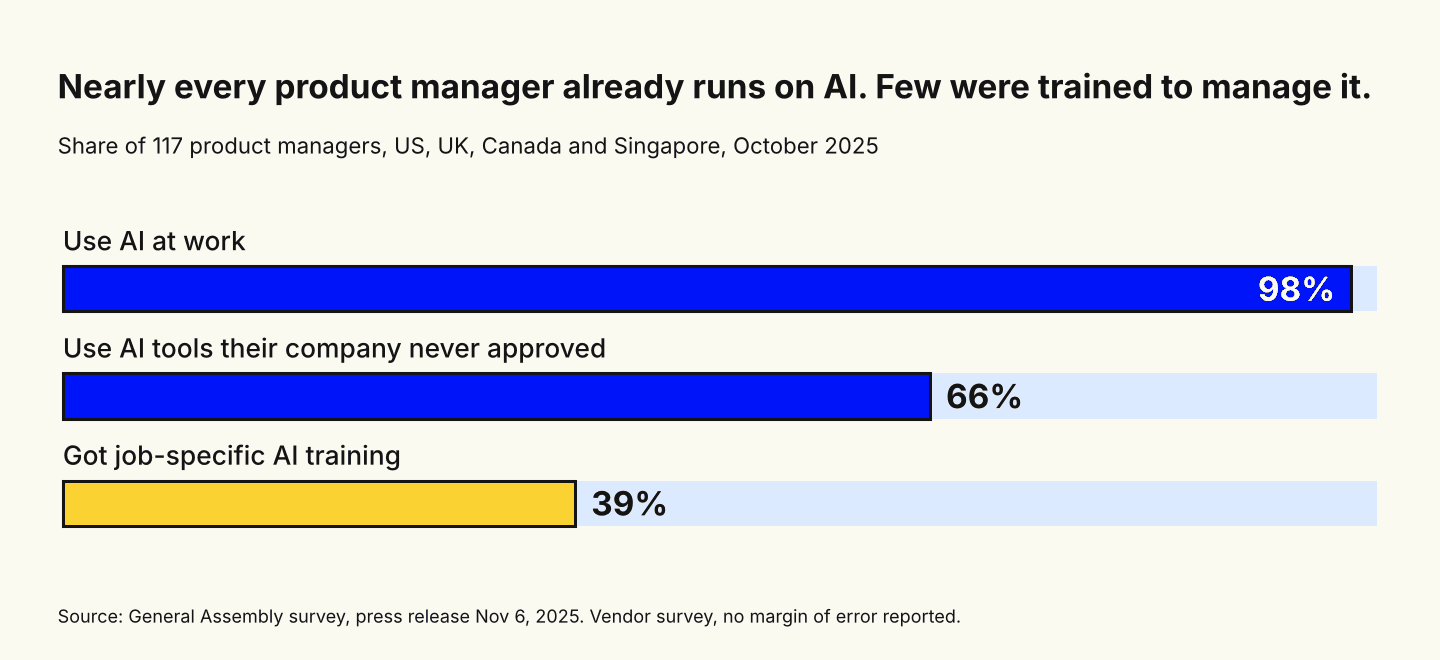
The two meanings share one skill set. Deciding what an agent may claim is the same problem as deciding what a customer-facing model may claim. Pricing a scheduled job is the same problem as pricing an inference call. Catching a confident wrong answer on a draft is the same problem as catching one in production. The difference is who sees the mistake first.
What changes when agents do the first draft
When agents do the first draft, the PM stops writing the output and starts writing the rules the output has to pass. Most of the hours move from producing documents to specifying context, defining done, and deciding what gets recorded after every run.
My practice runs this way now. One Claude plan carries about ten specialist agents, thirty-odd skills, and a set of scheduled jobs that run without me starting them. I covered the economics in the AI tools I pay for and the ones I keep cancelling, and the setup began with agents built on a 2018 MacBook that had sat unused under my desk. One job sweeps meeting transcripts and both inboxes each night and turns loose commitments into tracked to-dos. Another drafts a blog post from a ranked backlog and stages it for my review, which is how this post started.
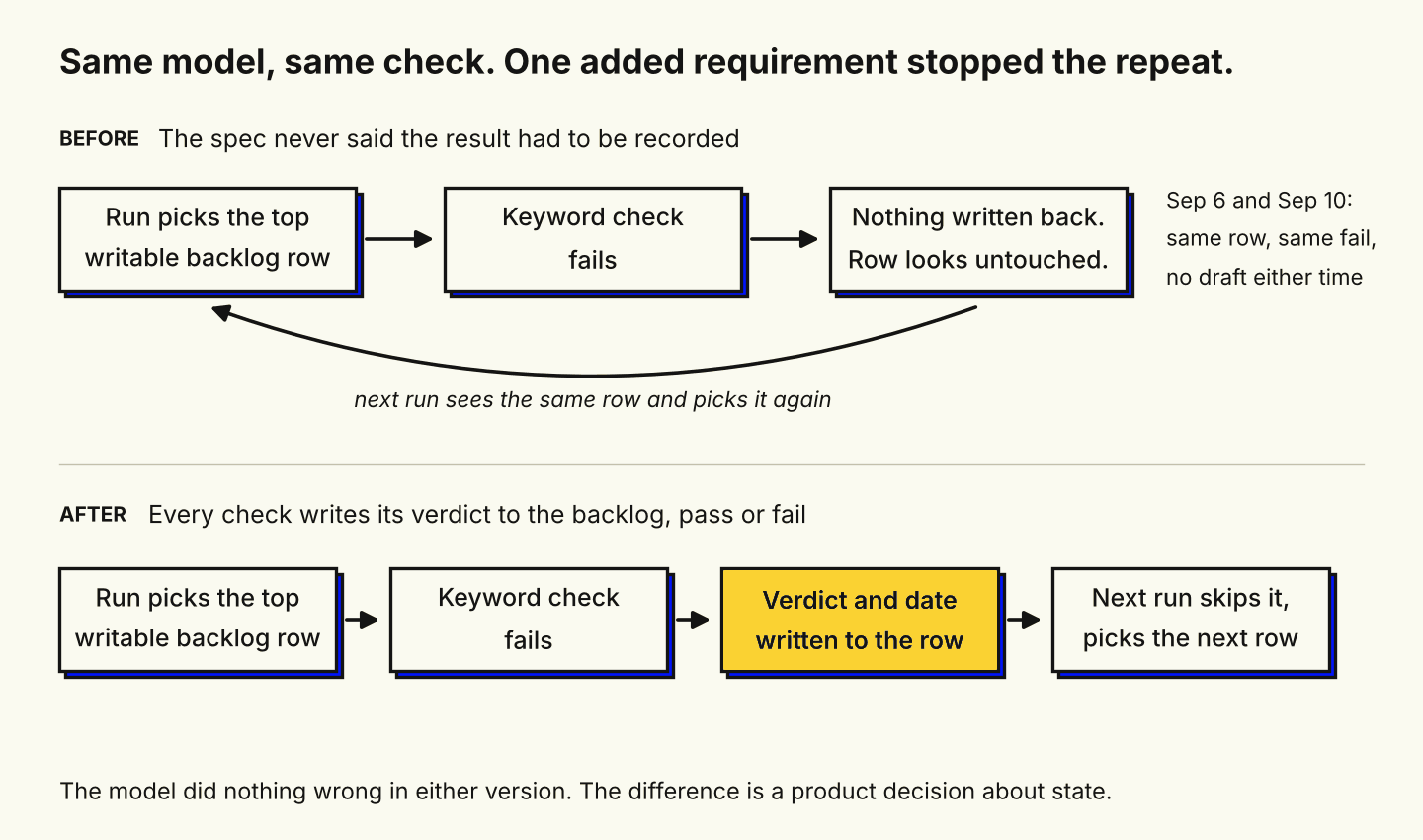
That blog job is where I learned where the PM work sits. In September it selected the same backlog item on two runs, four days apart. Both times it checked the keyword, failed it, and wrote nothing back. The next run saw an untouched row and picked it again. Two full runs produced nothing, and the model did nothing wrong in either one. My spec never said the result had to be recorded. The fix was one requirement: every keyword check writes its verdict to the backlog, pass or fail, before the run moves on. That is a product decision about state, the kind of gap a requirements review exists to catch. On my own system I shipped it.
The fastest way to become an AI product manager is to be the product manager of your own AI first.
How AI product management differs from the PM job you trained for
The role keeps the same responsibilities and changes what the PM produces for each one. The artifact moves from the document to the system that writes the document.
| Part of the job | What the PM produced before | What the PM owns when an agent does the first pass |
|---|---|---|
| Research and synthesis | The summary deck | Which sources the agent may use, and which it must never touch |
| Specs and drafts | The document itself | The context, the constraints, and the definition of done |
| Quality | A review before launch | A gate that runs on every output, including the ones nobody reads |
| Cost | Headcount and vendor contracts | Price per call, and which jobs earn a flat plan versus pay per use |
| Failure | Bugs that throw errors | Confident output that is wrong and passes every check |
The last row is the one the courses skip. Early in the build, I let Claude walk me through a configuration change that introduced a deprecated field. I made two more changes on top of it before anything broke. By the time the gateway stopped starting, I had three possible causes and no clean backup. Skipping backups cost me about ninety minutes across several sessions before I made it a habit. Every answer along the way was fluent and sure of itself. The fix was release discipline any PM already knows: one change at a time, test after each, back up before anything significant.
Cost works the same way. I pay for image generation per image through an API rather than carrying a standing image subscription, because the core model is weaker at that one job and a month of a standing tool costs more than a year of the images I make. Deciding which capability earns a flat plan and which gets called on demand is pricing work, and it is now part of the PM's job whether the customer is external or the PM.
None of this replaces the parts of the role that were always human. Deciding what to build, saying no, and getting a room to agree still sit with the PM. I wrote about how that ownership splits in product owner versus product manager, and how it moves again as a company grows in the CPO role changing every time the company doubles. AI moves the production work. The decision work stays where it was, and it gets more visible because there is less production work to hide behind.
How to become an AI product manager without a course
Become the product manager of one AI system you depend on, and run it like a product. Pick a job you do every week, hand the first pass to an agent, and own the spec, the gate, the cost, and the failure log.
The useful version of this is small and specific. Write down what the agent may and may not claim. Decide what done means before the first run, and decide what gets recorded after every run, pass or fail. Read the output on a schedule, and when it is wrong, change the system rather than the output. Track what each job costs you per month and cancel the ones that have not earned their keep by renewal.
The instinct is older than the tools. At EditMe, the SaaS company I co-founded, I instrumented the business by hand in SQL in 2010, with trial cohorts by signup month and lifetime value by cohort, rather than buy a tool to approximate the report I needed. Building the measuring system was the product job then. It still is. The system now writes as well as counts.
A course teaches the vocabulary. Running a system teaches the part the job pays for, which is knowing where the output will fail before it does. Every PM who uses AI at work, which is nearly all of them, already has a system to practice on.
The AI product manager title will settle into one meaning eventually. The work already has. The PM writes less of the output and answers for more of what happens when the output is wrong.