I joined TripAdvisor's product organization in 2013, ran hotel commerce, and later ran Instant Booking. It was a demanding place to build product. Specs got read line by line in a weekly review with the founder in the front row, and the company made two bet-the-company calls inside eighteen months while I was there.
Ten years after I left, I can still name where most of the people from that org ended up, and a lot of them are running product somewhere. That used to be a party trick. Then I wanted to know if it held up, so I mapped the public record on 170 people who held product roles at TripAdvisor between 2004 and 2024, using LinkedIn and a scraper.
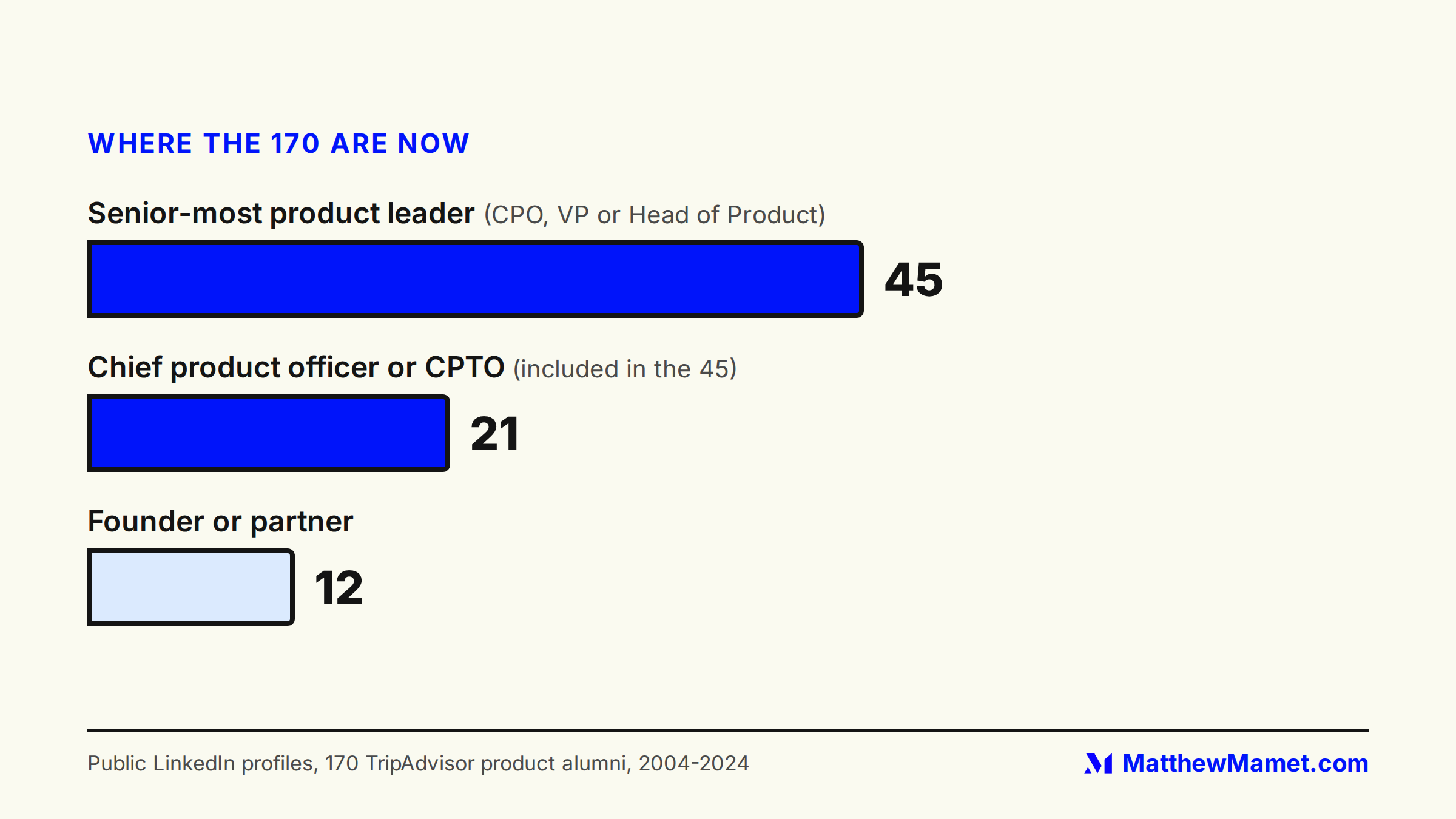
One hundred and seventy product people. Twenty-one are chief product officers today. Twelve are founders or partners. Forty-five are the senior-most product voice wherever they landed. They are at Miro and Zipcar and Axonify and OpenTable and Ethos and Breezeway and Raptive and Faire and USAFacts, and also at OpenAI, Anthropic, Google, Apple, Stripe, Figma, Uber and Instacart.
People in product circles have one word for an alumni network like that: mafia, after the PayPal one. I went looking for a TripAdvisor mafia and expected to find one. What I found instead is what professional football calls a "coaching tree", where one organization's leaders leave one at a time and go run other organizations, rather than founding companies together. Bill Walsh is the canonical case: his assistants became head coaches across the NFL and carried his system with them. The difference between the two shapes says a lot about how a product organization develops people.
Why mafia is the wrong label for TripAdvisor
The PayPal Mafia earned its name by encouraging members to found companies together while funding each other doing it. Peter Thiel's Founders Fund backed Thiel's former colleagues. Roelof Botha went to Sequoia. They took board seats in each other's companies, hired each other, and invested in each other's rounds. Wikipedia's own description of the group is that its members "worked together to form new companies and venture firms."
The companies were extraordinary: YouTube, LinkedIn, Yelp, Tesla, SpaceX, Palantir, Affirm. But that group moved inward, toward each other, building new entities with shared capital and a shared network. The people the network served best were its own members.
TripAdvisor's product organization moved a different way.
I wanted a second read from someone who had worked in both, so I spoke with David Chang. He was the first product manager TripAdvisor ever hired, as Director of New Products, a title that was itself an experiment, so he predates most of the people in this dataset. He later led PayPal's Boston office. Years ago he had sketched his own chart of where the Boston "WHERE mafia" scattered. What he noticed first was what ours lacked.
What was common was that people often moved together to do something new - a lot of reinvesting in each other. That's something I haven't seen in other places. - David Chang
A mafia reinvests in itself. A coaching tree sends its people out one at a time, and other companies collect the return.
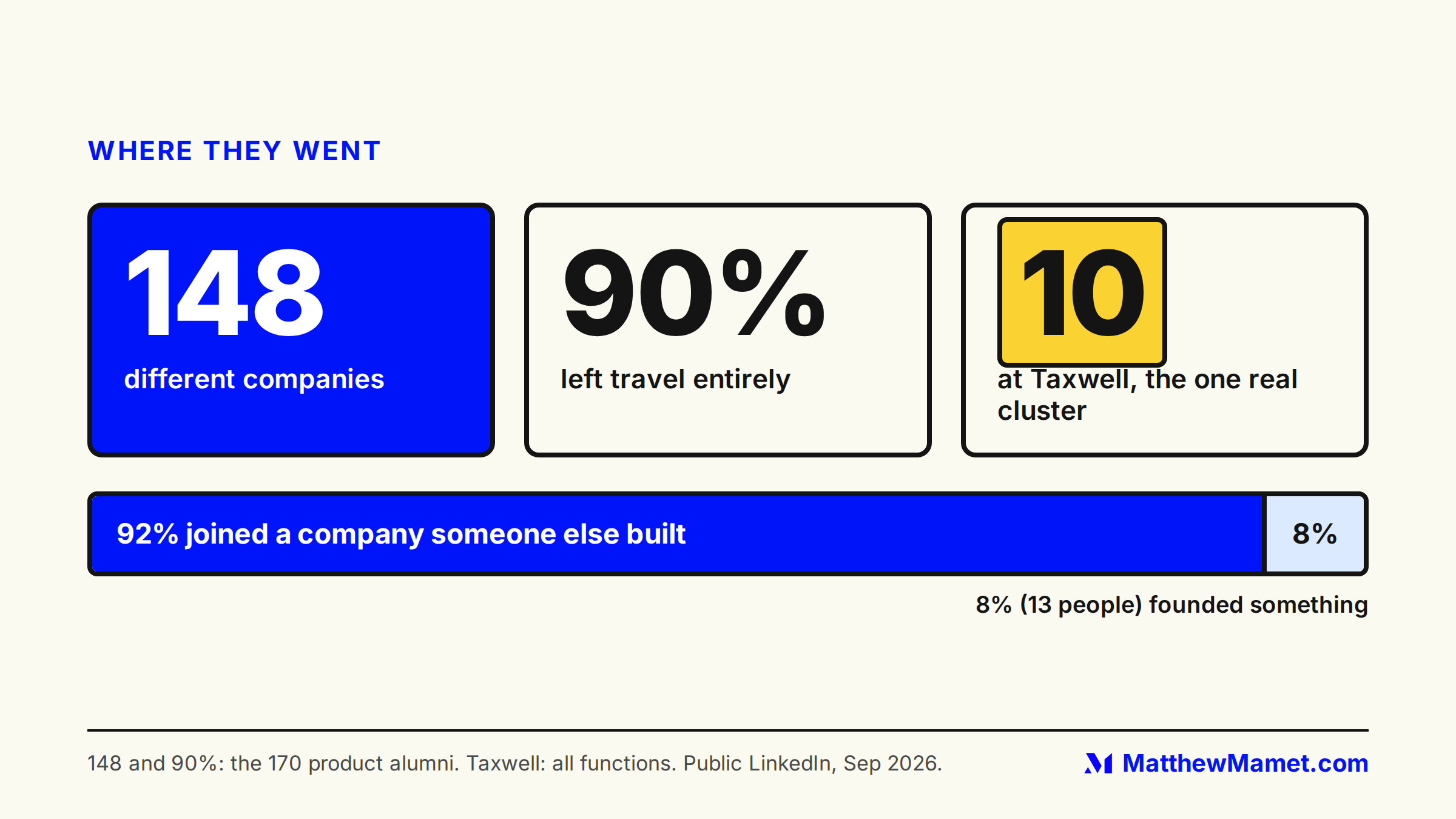
Thirteen of the 170 founded something - that's 8%. The other 157 went and joined a company somebody else had already built, and 45 of them now run product there. They went to 148 different companies, and no more than two of the 170 landed at any single one. They spread across commerce and marketplaces, consumer media, AI and developer tools, fintech and insurance, health, travel, and public interest work at USAFacts, Benetech and GivingData. Ninety percent left travel entirely.
When I showed David that maximum of two product people, he called it "mind-boggling." His guess is too many chefs in the kitchen, saying "I've lamented over a beer with old colleagues that we probably wouldn't find a way to work together again given how our skills have grown." Everyone left ready to run something, and a company only has one seat at the top of product.
There is no TripAdvisor fund, and with one exception I come back to below, almost nobody hired anybody. Nearly every one of these careers was won on the open market, at a company with no connection to TripAdvisor, against outside candidates, by someone who had to sit in an interview and explain why hotel metasearch experience mattered to a payments company or a design tool or a life insurer.
Boston has its own version of the PayPal Mafia. After eBay bought WHERE in 2011 and folded it into PayPal, its alumni went on to build and back each other, and BizJournals mapped them in 2014 as the WHERE Inc. mafia. David was inside it, and he sorts what made it a mafia into four behaviors:
- Alumni co-founding startups together.
- Alumni-founded companies taking money or a board seat from another alum.
- Several alumni joining the same company.
- Alumni banding together as angels or in a fund.
Run TripAdvisor's product org through the same test and it scores close to zero on three of the four. Eight percent founded anything at all. There is no fund and no angel syndicate. On the third behavior, several alumni joining the same company, the product roster says no company has more than two. Widen the lens past product titles and there is one clear exception, which gets its own section below.
There is already a name for this shape
It comes from professional (american) football, and it is a coaching tree.
A head coach develops assistants. Those assistants leave and become head coaches at other franchises, taking "the system" with them. Their assistants do the same thing a decade later. The tree is measured not by what the original team won, but by how many other organizations its people went on to run, and how those organizations did.
Bill Walsh is the canonical root. Six of his direct assistants became NFL head coaches, and the branching went generations deep: Walsh to Mike Holmgren to Andy Reid to Doug Pederson and John Harbaugh, Walsh to Mike Shanahan to Sean McVay and Kyle Shanahan. The West Coast offense system spread through those branches into franchises that had nothing to do with San Francisco. NFL.com's summary of the effect is that since Walsh's first title after the 1981 season, thirty of the next thirty-seven championships went to Walsh, Joe Gibbs or Bill Parcells, or to their descendants.
That is our product org, and it is the opposite of a mafia where it counts. A coaching tree's branches compete with each other. They do not fund each other. Nobody gets a board seat from an old boss. The unit of success is somebody else's team getting better.
PayPal's people built a compound and funded each other inside it. TripAdvisor's went out one at a time and made 148 other organizations better from the inside.
Business has a nearby term already. Harvard Business Review calls them academy companies, firms that export more leaders than they keep, and its 2023 ranking puts McKinsey, Google, Microsoft, Unilever and GE at the top. That points the right way, but it describes a pool. A coaching tree describes a lineage, with generations and a scoreboard, and lineage is what the data shows.
Trees can also fail. Bill Belichick's assistants have a combined head coaching record of 206 wins, 291 losses and a tie, and only one of them finished above .500. Producing coordinators is not the same as producing head coaches, and a company that exports a lot of people is not automatically exporting leaders.
Plenty of companies shed people. The question is whether the people who left became head coaches, and if so, what the organization did to make them that.
If a diaspora clusters, you cannot separate the quality of the people from the strength of the network, because the network is supplying the advantage. This one does not cluster. What is left is 148 independent hiring committees reaching roughly the same conclusion, with nobody in the room doing anybody a favor.
Why it went outward
The data shows which shape TripAdvisor was, not why. So I went back to David.
His answer is that the founder decides. "It seems clear that the founder/CEO, not the industry, drives the culture," he told me, "and that drives whether the org becomes a magnet and breeding ground for the next mafia that reinvests, or a coaching tree that spreads talented people into the world."
At WHERE, the CEO was Walt Doyle, and Walt pushed people out the door on purpose. "Walt Doyle actively encouraged people to go off and do the next big thing," David said. "Every person on my product team later became CEO of their own venture." David still sees Walt every week, and Walt is informally helping with his current startup. That is what a mafia looks like from the inside: the old boss is still in the room a decade later. David puts HubSpot and Klaviyo in the same group. People left those companies in groups rather than one at a time, and kept backing each other.
TripAdvisor went the other way, and David's read is that this also came from the top. Leadership believed there was still a lot left to do inside travel. When the people running a company think its category is unfinished, encouraging your best people to go start the next big thing is not in the water. He describes the culture as more insular, "not in a bad way," and says it showed up in small decisions rather than stated policy.
That matches the numbers. Nobody at TripAdvisor was sent off to build something. People left one at a time, when they were ready to run a product org, and went wherever that job was.
The mafia motion is getting the band back together to make a new album. - David Chang
The mafia inside the tree
This research focused on people who held product titles at TripAdvisor. Widen it to every function and one company stands out.
Dermot Halpin ran Vacation Rentals for Steve, and later Attractions and Vacation Rentals, from 2011 to 2020. In December 2022 he became CEO of Taxwell, the parent of TaxAct and Drake Software. Four months later his CTO and his CPO were both TripAdvisor alumni: Sugata Mukhopadhyay, who ran engineering for Dermot's division before becoming TripAdvisor's CTO, and Bastien Martini, who ran traffic for Attractions and Rentals. A former TripAdvisor VP of customer operations became chief customer officer two months after that. Engineers followed the CTO for the next three years.
By public LinkedIn records, at least ten TripAdvisor alumni have worked at Taxwell, and at one point four of its C-suite seats were held by people from TripAdvisor. None of them show up in the product roster, because none of them held a product title there.
That is the mafia pattern: several alumni joining the same company, as a group, behind one leader. The cause here is one executive who, once he ran his own company, rebuilt the team he trusted. It is David's point from the other direction. The person at the top decides which shape you get, and a coaching tree can grow a mafia on any branch where someone becomes a CEO and wants their crew back.
The org grew its own
Sixteen of the 33 people who now hold a chief product officer or founder title entered TripAdvisor below director level. Forty-seven percent of the whole group held two or more distinct roles inside the company.
Adam Medros is the cleanest version of this. He joined in 2004 as a senior product manager. He left in 2017 as SVP of Global Product, running an organization of roughly 350 people across 49 points of sale and 28 languages. He is a chief product officer again now, at Aura.
The person who ran the org had been one of its junior hires. He was given something real early, and later ran an org that did the same for others on purpose.
Most companies get this backwards, and I see it in most of the companies I work with now. The instinct when there is a gap at the top of product is to go buy a senior person with a good logo. Sometimes that works. More often you end up with one strong hire and the same thin bench you started with, and two years later the gap is exactly where it began because nothing underneath ever changed. I have written before about hiring senior product talent when recruiters cannot reach it, but hiring is only half of it. The other half is what you hand someone in month three.
The bar outlived the founder
I would have bet against this one.
Steve Kaufer ran TripAdvisor on data long before that was fashionable, and for years he was personally in the loop on most hires. At some point a company gets too big for that. The usual outcome is one of two failures: the founder stays in every loop until it becomes the bottleneck, or he steps out and the bar quietly collapses because nobody wrote down what he was actually testing for.
Neither happened. People hired between 2008 and 2012, when Steve was still in most senior loops, are in senior product roles today at 45.0%. People hired between 2013 and 2017, under an institutionalized process, are at 39.4%. Both cohorts have had nine or more years to rise.
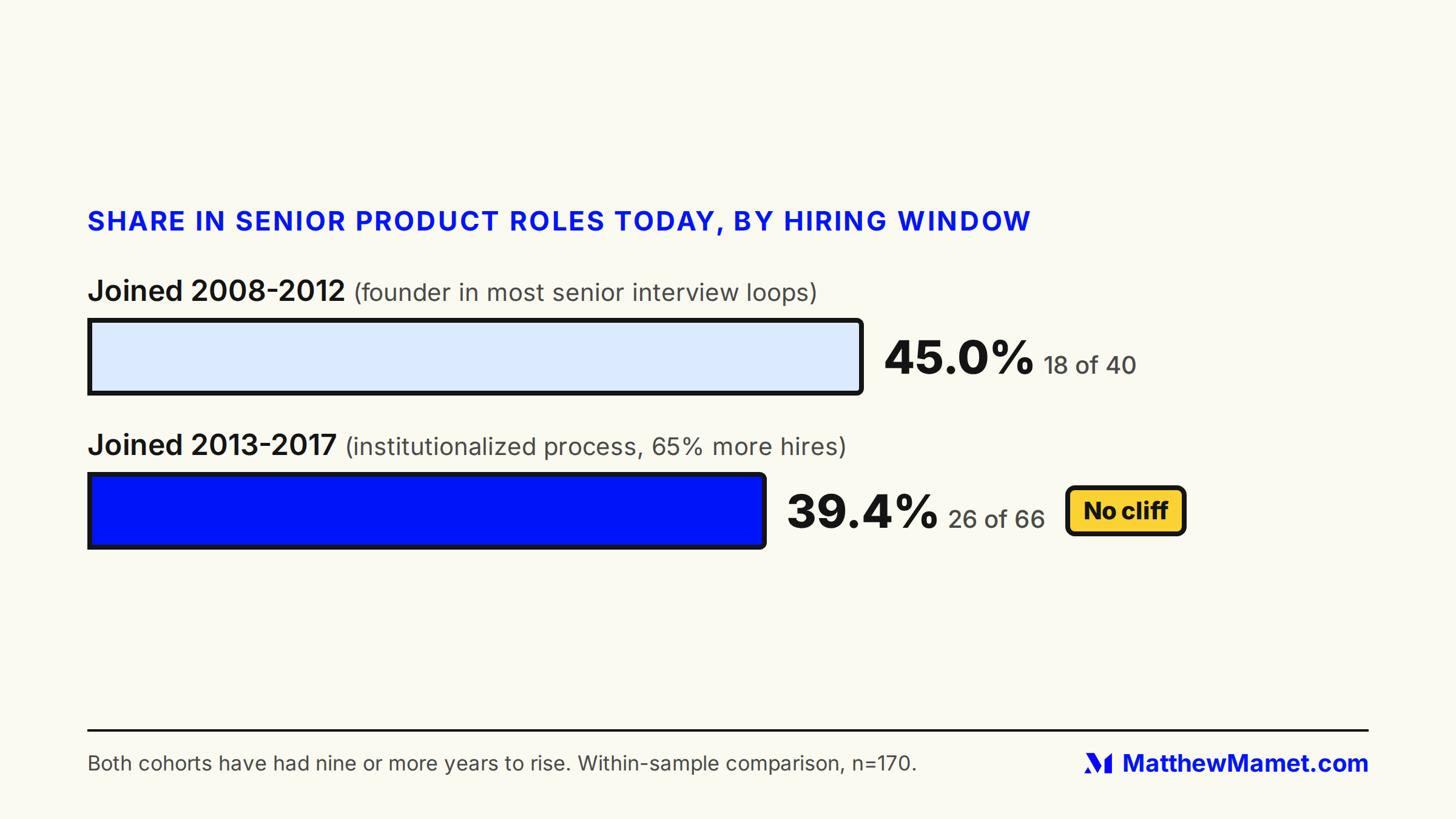
And the second window is when they hired 65% more product people than the first, because that was the Instant Booking build-out. Hiring surges usually lower the bar. This one did not.
I am a data point in this. I came in as a director of product for hotel commerce in 2013, and I was one of very few directors at that time hired without Steve personally interviewing me. I arrived exactly at the seam. From the inside, it felt like a process that knew what it was looking for. The numbers say that impression was roughly right.
Two bets, eighteen months apart
In June 2013, hotel metasearch finished rolling out to every market. It worked. Click volume fell by roughly three times and conversion rose by roughly three times, and revenue growth went from 19.8% in 2012 to 23.9% in 2013 to 31.9% in 2014. The company crossed $1.25 billion. That was a bet-the-company moment and it paid off, and I got to watch the reasoning up close because I was running hotel commerce while it happened.
In June 2014, Instant Booking launched. By September 2015 it was on every platform in the US and UK with six of the top ten global hotel brands and more than 235,000 bookable properties. Then revenue fell 0.8% in 2016 after five straight years of twenty-plus percent growth, the stock dropped 21.6% across February 2017, and the company walked the product back. I ran Instant Booking as a senior director from 2015. I own that one.
Two enormous bets in eighteen months, resolving in opposite directions, in front of everybody.
Among people who left TripAdvisor as product managers or individual contributors, the ones who were there for both bets are in senior roles today at 46.4%. The ones who were not are at 22.6%. The both-bets group lands level with the people who left as directors, at 50.0%.
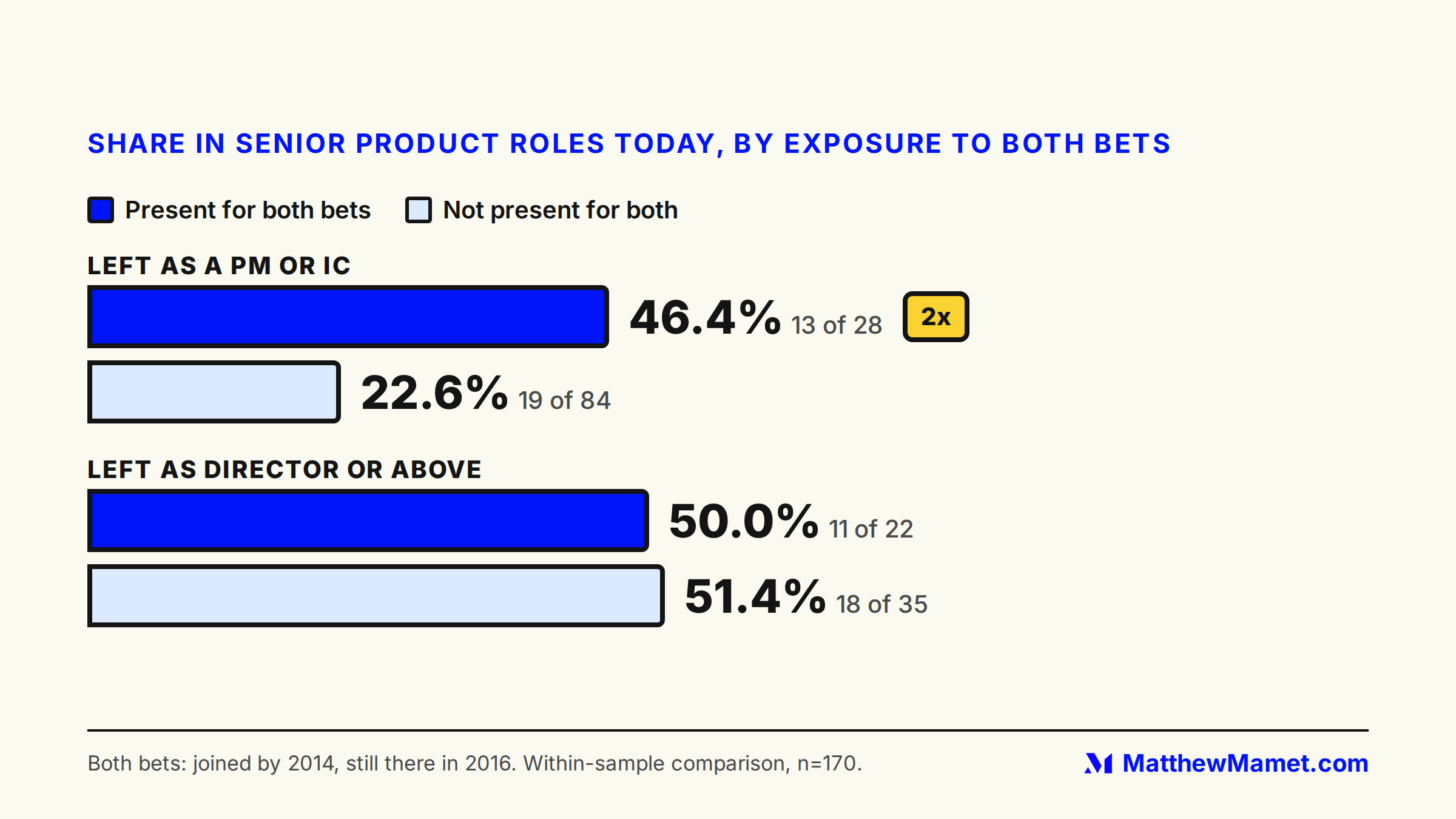
Sitting there longer does not reproduce it. Junior people who stayed four or more years but missed the pairing come in at 26.7%. Duration is the wrong variable. Presence at the moment two big bets resolved in opposite directions is the right one.
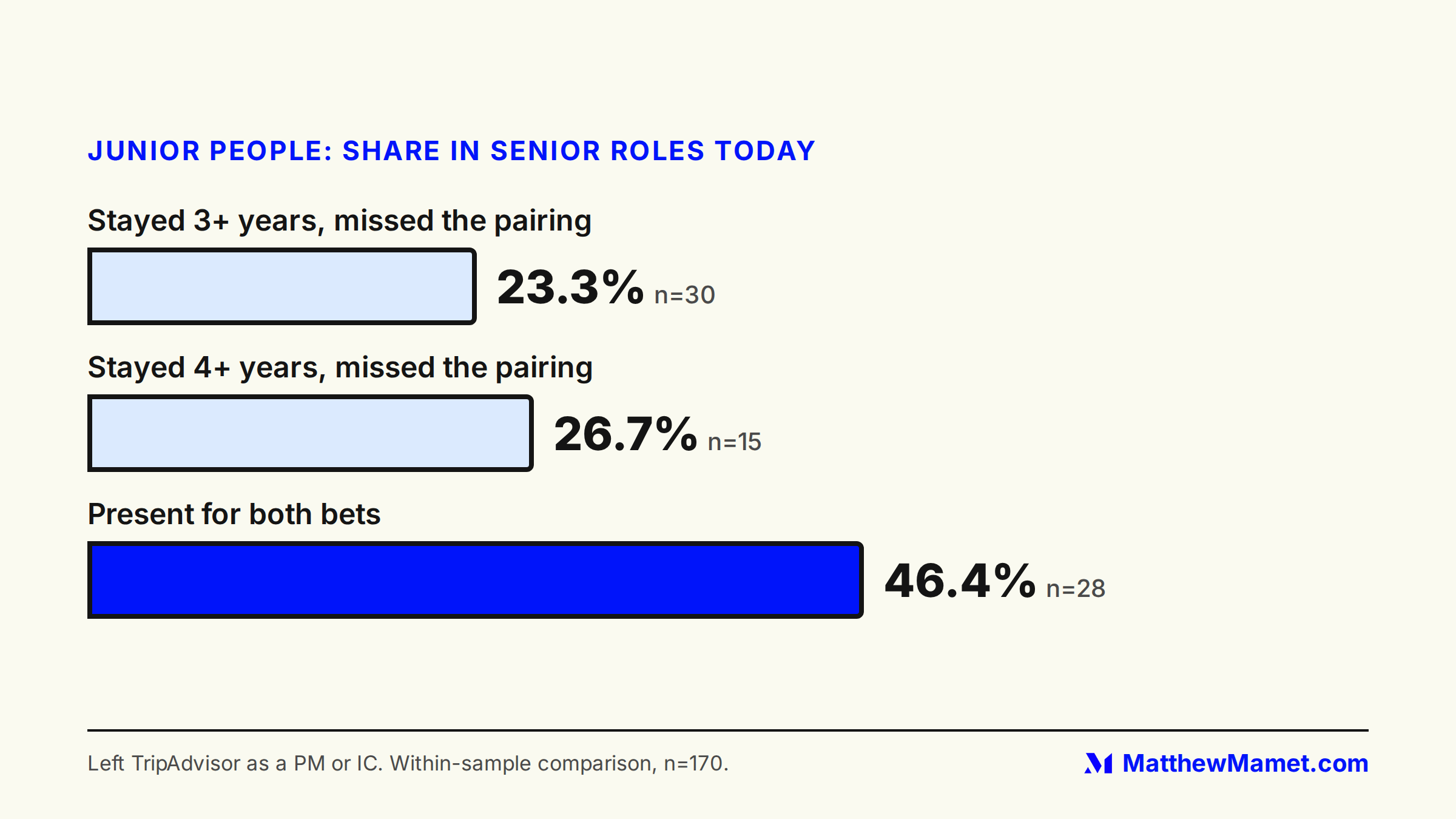
The caveat: that comparison rests on 28 people on one side. It holds across every cutoff I tried, and the tenure placebo rules out the obvious alternative, but it is still 28 people.
The failure alone taught much less; people who arrived after metasearch shipped and only lived through the unwind sit at 29.3%, barely off the baseline. You need the win and the loss. One outcome is an anecdote. Two with opposite signs is a calibration, and calibration is most of what senior product judgment is.
Duration taught nothing. Twenty-eight junior people who happened to be present when two company-defining bets resolved in opposite directions caught up to the directors.
The organizational credit belongs where Adam put it. Junior people were close enough to both bets to see the arguments, not just the outcomes. Most companies keep their juniors well away from anything that frightening, then wonder why the bench is thin.
The craft held
Eighty-five percent of all 170 are still working in product today. Among those who left nine or more years ago, 86%.
That number surprised me more than any of the others. Product management leaks badly into general management, operations, consulting and founding. A decade out, almost nobody drifted.
And 90% of them left travel entirely. Whatever they were taught, it was not domain knowledge about hotels. It transferred to fraud and risk at Expedia, to AI product at Wayfair, to platform at Uber, to design systems at Figma, to conversational AI at Mapbox, to a life insurance marketplace at Ethos, to public data at USAFacts.
That is the strongest available evidence that what the org built was judgment rather than familiarity. Familiarity does not survive a category change.
What the numbers cannot see
I started this expecting the mechanism to be the weekly product review meeting. Four minutes a presenter, real specs instead of slide decks, the founder in the front row asking the question that found the hole in your logic. I have said in print that I believe it is one of the single biggest reasons Boston produced a generation of product leaders, and I still believe that.
Every product manager in that organization went through product review. There was no cohort that skipped it. When a treatment is applied to everyone, there is no variation left to measure against, so this dataset cannot see the meeting's effect at all. Absence of a signal here is a limit of the method rather than a verdict on the meeting.
The MBA rotation program is a different case, because only some people went through it. That one is testable, and it comes back flat. Rotation entrants reached senior roles at 37.5% against 33.3% for other junior hires, on eight people. Ravi Mehta built a good program and I have written admiringly about it. By the numbers, it did not outperform traditional sources of talent.
I would now put one thing differently. I have written that this group was not a hiring fluke, and I stand by the spirit of that. Nobody got lucky. But the numbers give selection more credit than I did. Sixteen of the 33 people at the top of this roster entered below director level, the bar held through a 65% hiring surge, and the single strongest predictor of where anyone ended up was the level they reached before they walked out the door. The environment was real. The filter in front of it was doing more work than I gave it credit for.
None of this says a coaching tree beats a mafia. A mafia builds companies and wealth for its own members, and the WHERE alumni did well by each other. A tree spreads the value across other people's companies, which is good for the industry and less obviously good for the people in it. They are different outcomes, and a founder could reasonably want either one.
What I would actually copy
Three things, in the order I would do them.
Hire people slightly before they are ready and then give them something that scares you a little. The roster's clearest signal is that half the top outcomes came in below director level. You cannot get that result by only hiring people who have already done the job.
Write down what your best interviewer is testing for, while they are still available to ask. TripAdvisor's bar survived a 65% hiring surge and the founder stepping out of the room. That does not happen by accident and it does not happen retroactively.
Stop rotating people off things before those things resolve. This is the one I would change first in most organizations I see. If your biggest bet takes three years to land and your rotation cadence is eighteen months, you have designed away the only development mechanism in this entire dataset, and then you will fund a leadership development program to fix the shortage you created.
A product organization is a curation system, and the way to grade one is to wait a decade, see what the market did with the people who left, and count how many of them are running somebody else's product org now. Forty-five. Across 148 companies that owed TripAdvisor nothing.