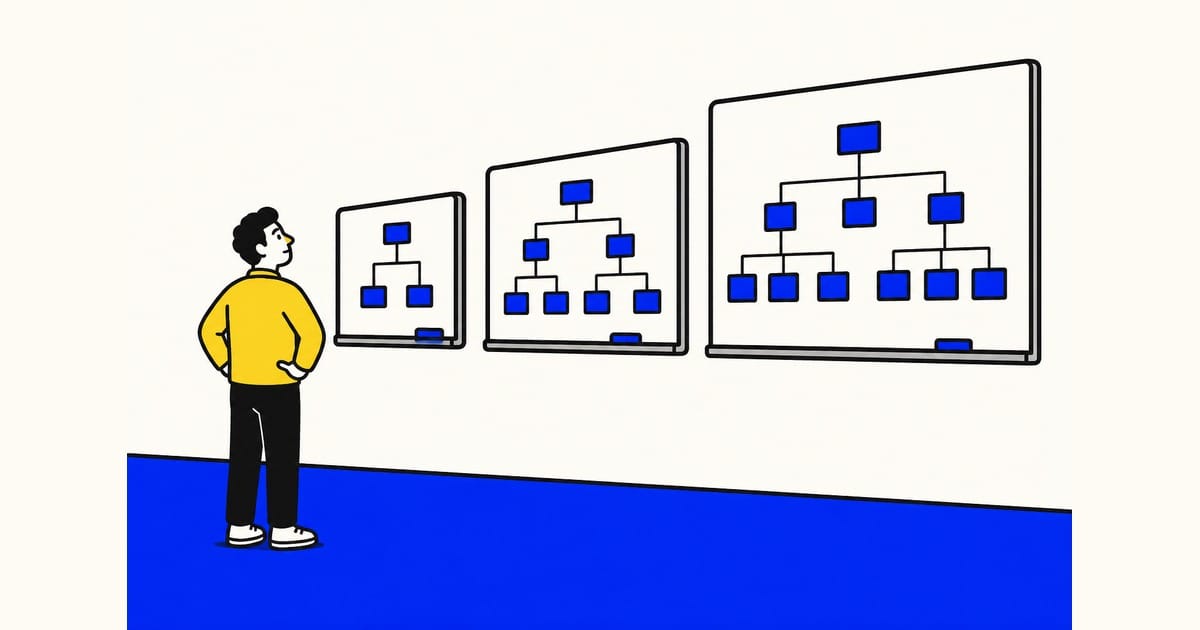

A fractional executive is a senior leader who works with a company on a part-time or project basis - typically a few days per month - without joining as a full-time employee. The arrangement gives growing companies access to experienced leadership at a fraction of the cost of a full-time hire, and gives the executive the ability to work across multiple companies simultaneously. The model has existed for decades under different names. The word "fractional" is relatively recent.
Before anyone called it fractional
In the spring of 2009, I left a full-time role and started taking on advisory work. I was not trying to build a practice. I was trying to stay useful while I figured out what came next.
The first client was HuStream, a video personalization startup. Then Awareness Inc, a social media marketing platform. Then Zmags, a digital publishing tool. Three different companies, three different problems, three different industries. What they had in common: they needed senior product and growth thinking and could not justify - or did not want - a full-time executive hire.
I was charging $800 a day. I was working roughly four days a month per client. I had made myself a rule: no more than four clients at a time. Above that, the work gets thin and the clients start to feel it. Below that, you have enough context in each engagement to actually move the needle.
Nobody called this fractional. The word barely existed in this context. I called it consulting. Clients called it advisory. What it actually was: a repeating engagement model where I held an ongoing seat at the table without filling a full-time role.
What made it work then - and what makes it work now
The model works because of a timing mismatch that is structural in how companies grow. A company at 30 people doing $3M in revenue does not need a full-time CPO. It needs someone who has built a product organization before, can help them sequence their roadmap, and can identify the three things they should not be doing. That engagement is four days a month, not twenty. Hiring a full-time executive for that work is expensive, slow, and frequently wrong - you get someone optimized for a company three times your size, running processes that do not fit yet.
The fractional model fills that gap. The executive gets enough context to be genuinely useful. The company gets senior judgment without the overhead. The work gets done.
The thing that kills it is scope creep in the wrong direction. Fractional works when the scope is clear: I own this problem, I show up on these days, I deliver against these outcomes. It breaks down when it slides into general availability - the client starts treating you like an employee they can ping anytime, and you start treating the engagement like a job you have not fully committed to. Neither side wins that version. The line between fractional and overemployment is a scope question, not a time question.
The value of the fractional model is concentrated senior judgment. That judgment has a carrying capacity. Spread across too many clients, it becomes thin.
Why 2009 was the right moment
The 2008-2009 recession created conditions that were unusually favorable for this model. Companies that had over-hired were cutting full-time headcount. The work still needed to get done. The market for senior part-time talent opened up faster than most people expected. The constraint of limited resources accelerated the search for flexible executive capacity.
It was not glamorous. One morning after breakfast I told my kids I was heading in to work. My six-year-old - precocious in the way that only six-year-olds can be - looked up and asked, "Do you mean the basement, daddy?" She was right. I was working out of a home office that was, in fact, a basement. The category did not have a name, the rate was not something you said out loud at dinner parties, and the commute was a flight of stairs. That is what the beginning of something looks like before it becomes a category.
I benefited from that timing, but the model did not depend on it. What I was doing in 2009 with HuStream and Zmags is structurally identical to what I do now. The companies are larger. The problems are more complex. The category has a name. But the core arrangement - senior executive, part-time engagement, specific scope, ongoing seat at the table - is the same.
What has changed is the supply side. In 2009, the people doing this kind of work were mostly former executives between jobs or semi-retired operators picking up a few projects. There was no community, no common vocabulary, no playbook. By 2024, there are networks, pricing frameworks, certification programs, and enough practitioners that buyers have developed real opinions about what good looks like. The category matured.
The four-client rule still holds
The constraint I set in 2009 - no more than four active clients - was intuitive at the time. I had not run the math. I just knew that above a certain number, the quality of my thinking in each engagement started to drop. You can feel it before clients can, which means you are already delivering worse work by the time it becomes visible.
I have tested the limits of that constraint since then. The number is roughly right. The exact limit depends on engagement intensity - a deep fractional CPO role where you are attending weekly leadership meetings and running a product team is not the same as a lighter advisory retainer where you show up twice a month for a strategic conversation. But the principle holds: the value of the fractional model is concentrated senior judgment, and that judgment has a carrying capacity. Spread across too many clients, it becomes thin.
The companies that get the most out of a fractional CPO or CGO engagement are the ones that treat it as a real leadership role with a defined scope - not a consulting retainer with open-ended availability. They give the executive enough access to understand the business, enough authority to influence decisions, and enough continuity to build context over time. The ones that treat it as an on-call advisory service get on-call advisory service quality. The distinction matters more than the pricing.
What the model is actually solving
The fractional executive model is solving a sequencing problem. At some point in a company's growth, the founding team runs out of the specific expertise the business needs next. They are not ready to hire a full-time executive - the role is not fully defined, the budget is not there, or they want to test the fit before committing. They need the judgment before they need the headcount.
That window - between needing the expertise and being ready to hire for it full-time - is where the hardest product decisions get made. It is also where the most value gets left on the table when there is no experienced operator in the room.
That is the window the model was built for. It was built for that window in 2009, when I was working with a video startup and a social media platform and a digital publisher, none of whom could justify a full-time product or growth executive. It is still built for that window now. The category has grown up around a problem that has not changed.
They need the judgment before they need the headcount. That is the window the fractional model was built for - and it has not changed since 2009.