
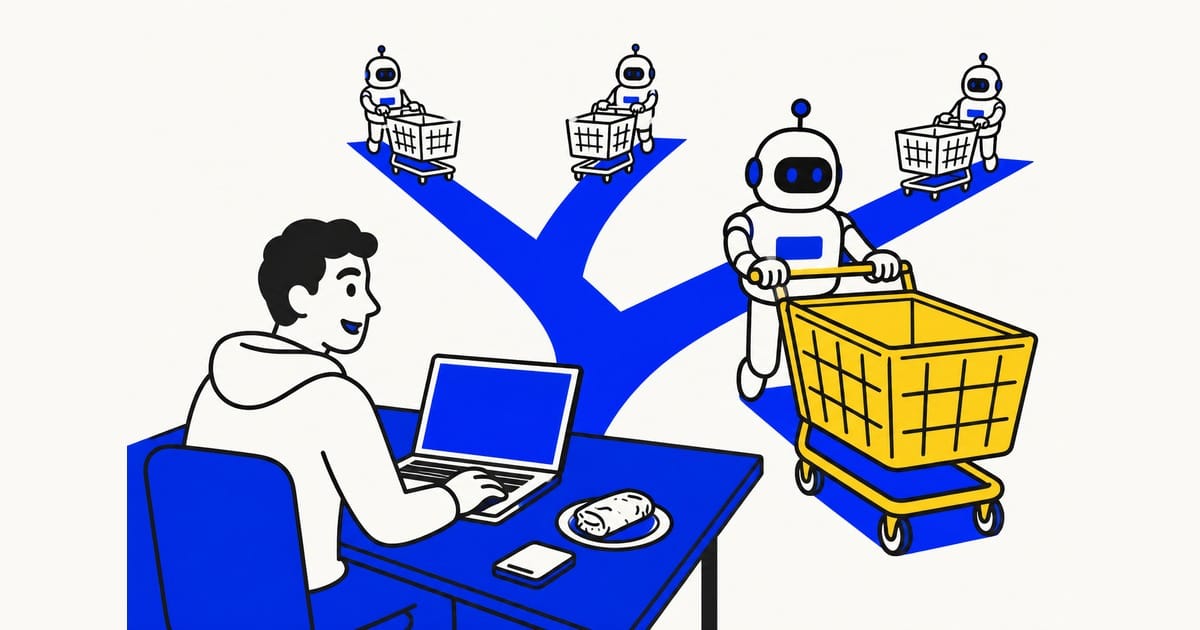
Agentic commerce - completing purchases inside an AI interface rather than a traditional website - is the next major battleground in e-commerce. Walmart, Alibaba, Amazon, and Google have each made a distinct structural bet on how to solve it. The companies that get it right will be the ones where the AI lives inside the trust infrastructure, not on top of it.
Last month I wrote about Walmart killing ChatGPT Instant Checkout after conversions came in 3x worse than their own site. PhocusWire picked it up. The response I kept getting was some version of: "so agentic commerce does not work."
That is not what I said. And the last two weeks have made the actual argument much clearer.
Four major players have now made distinct, incompatible bets on how to solve the same problem. They cannot all be right.
The problem, if you have not been following: the trust infrastructure that converts a browser into a buyer is not in the checkout button. It is in everything around it - the reviews, the return policy, the brand context that signals "this transaction is safe." When you move the transaction into a new interface, that infrastructure does not automatically come with it. You have to rebuild it, or find a way to bring it.
I know this because I watched it happen at TripAdvisor with Instant Booking. We had 200 million reviews and more hotel traffic than anyone on the planet. We built a checkout layer on top of that and assumed the trust transferred. It did not - not right away. Travelers trusted the hotel's own site or the OTA they had used before. We had the traffic but not the purchase trust. It worked eventually, but we fought headwinds the entire way. I wrote about the full ecommerce arc - from $0 to $200M at TripAdvisor - if you want the longer version.
That was 2014. The question everyone is now trying to answer is the same one we were trying to answer then, just at a different layer of the stack.
Here are the four bets.
Bet 1: Borrow the platform, lose the context (Walmart / ChatGPT)
OpenAI and Stripe launched Instant Checkout last September - a clean protocol for completing purchases inside ChatGPT. Walmart was one of the early partners, testing across 200,000 SKUs.
The result: conversions were 3x worse than Walmart's own site. OpenAI has since pulled back from Instant Checkout entirely, moving toward ChatGPT apps that hand off to merchant environments rather than completing the transaction in-chat.
The diagnosis is straightforward. When a customer lands on Walmart.com, the whole context signals safety. The reviews are Walmart's. The return policy is Walmart's. The brand is everywhere. Inside ChatGPT, that context evaporates. You are buying from the conversation. Nobody has built enough purchase trust in the conversation yet to convert at scale.
This is not a payment infrastructure problem. Stripe is perfectly capable. It is a trust infrastructure problem. And Instant Checkout tried to solve it by skipping it.
This is not a payment infrastructure problem. Stripe is perfectly capable. It is a trust infrastructure problem. And Instant Checkout tried to solve it by skipping it.
Bet 2: Own the whole stack (Alibaba / Qwen / Fliggy)
Alibaba's approach is the structural opposite of Walmart's. Rather than transacting inside someone else's AI, they built the AI inside their own ecosystem.
Qwen is Alibaba's model. Alipay handles payment. Amap handles location and logistics. Taobao and Tmall supply the product catalog. Fliggy handles travel - air, rail, attraction tickets, hotels. The shopping never leaves the Alibaba environment. The trust signals do not have to transfer because there is no transfer.
The numbers are not theoretical. During the Chinese Spring Festival this year, Alibaba processed over 200 million AI-native shopping orders through Qwen. Fliggy reports that conversion performance in AI-driven booking flows is now comparable to - and in some cases improving versus - traditional booking flows.
That last data point matters. Comparable conversion to traditional flows is the benchmark everyone else is trying to reach. Alibaba is reporting they are there, at least in travel categories.
The obvious caveat: this works because Alibaba owns everything. The trust is intact because the user never crosses a context boundary. That is a structural advantage almost nobody else can replicate. Amazon can. Google is close. Everyone else is working with someone else's infrastructure.
The less obvious caveat: Fliggy's strong numbers are in air, rail, and attraction tickets - relatively low-consideration, high-frequency travel purchases. Hotels, packages, and complex itineraries are a different trust problem. The TripAdvisor lesson was not about discovery. It was about what happens when something goes wrong after the booking, and who the customer trusts to fix it.
Bet 3: Rebrand trust (Amazon / Alexa for Shopping)
Last week Amazon retired its Rufus chatbot - 300 million users, 115% monthly active user growth year over year, engagement up nearly 400% - and replaced it with Alexa for Shopping.
That is a striking move. You do not discontinue a product with those metrics because it is failing. You discontinue it because the brand is the constraint.
Amazon's diagnosis appears to be: Rufus required consumer education. "Ask Alexa" is already a habit in hundreds of millions of households. The capability was not the problem. The trust signal attached to it was. Folding the agent into Alexa is a distribution decision dressed up as a product decision.
What Alexa for Shopping actually does: it lives in the main Amazon search bar, draws on purchase history and Alexa conversations across all devices, compares products, tracks prices, and can execute purchases automatically when price targets are hit. The agent now sits inside every search interaction on a platform where consumers already trust the transaction.
This is a different solution to the same problem. Amazon is not solving trust - they are borrowing it from a brand that has had it for a decade. The bet is that Alexa's existing trust transfers to a shopping agent inside Amazon's own environment.
We will find out.
Bet 4: Build a protocol, let the market figure out the trust (Google / UCP)
Google's Universal Commerce Protocol, announced in January 2026, is a different kind of bet. Rather than owning the ecosystem or borrowing an existing brand, Google is building the infrastructure layer that allows AI agents to transact across merchant environments while preserving each merchant's trust context.
The idea: an OTA or hotel chain does not have to rebuild trust inside Google's AI because the protocol maintains the relationship between the consumer and the merchant. Google's AI Mode can complete the booking, but the consumer is still transacting with Booking.com or Marriott - not with Google as an anonymous intermediary.
Google is reportedly working with Booking.com, Expedia, Marriott, IHG, Choice, and Wyndham on agentic travel booking inside AI Mode, though they are being deliberately careful about timeline. "We're not going to rush this out the door because we want to make sure that it's a seamless experience and that people have all the control that they need," Julie Farago, Google's VP of engineering for travel and local search, told PhocusWire.
The protocol bet is architecturally elegant. If it works, it solves the trust problem without requiring Google to own everything the way Alibaba does, and without the brand-borrowing risk Amazon is running with Alexa. The merchant's trust infrastructure comes through the protocol intact.
The risk: protocols are slow, and trust is not just structural. Consumers need to experience enough successful transactions through UCP before they stop thinking about who they are actually buying from. That takes time and volume. Alibaba has the volume already. Amazon has the brand already. Google has the protocol and the search dominance, but the agentic transaction habit is still being built.
This dynamic is worth watching alongside the broader question of what happens to comparison marketplaces when AI agents replace the comparison step entirely - a related disruption playing out in parallel.
The companies that crack agentic commerce are the ones where the AI lives inside the trust infrastructure - not on top of it, not borrowing it, not routing around it through a protocol.
So which bet is right?
Probably not one of them cleanly. But here is the pattern I see from having built the earliest version of this problem:
The companies that crack agentic commerce are the ones where the AI lives inside the trust infrastructure - not on top of it, not borrowing it, not routing around it through a protocol.
Alibaba is closest to that today, but only in their own closed market. Their structural advantage does not export.
Amazon's Alexa bet is the most interesting one to watch in Western markets, because they are the only player outside China that has both the transaction trust and the ambient AI presence at household scale. If "Ask Alexa to buy this" becomes a habit the way "Google it" became a habit, the Rufus discontinuation will look like a very smart call.
Google's UCP is a longer game. The OTAs sitting inside a well-designed protocol are probably fine. The ones that miss the protocol integration window are not. If you want to understand where marketplace dynamics are heading more broadly, the protocol layer is the place to watch.
And Walmart's Instant Checkout failure is not a verdict on agentic commerce. It is a verdict on what happens when you try to relocate a transaction without relocating the trust.
I was half right about Instant Booking in 2014. We built the checkout. We underestimated how long it would take to earn the purchase trust in a new context.
Everyone is making the same bet now. The timeline is just compressed.