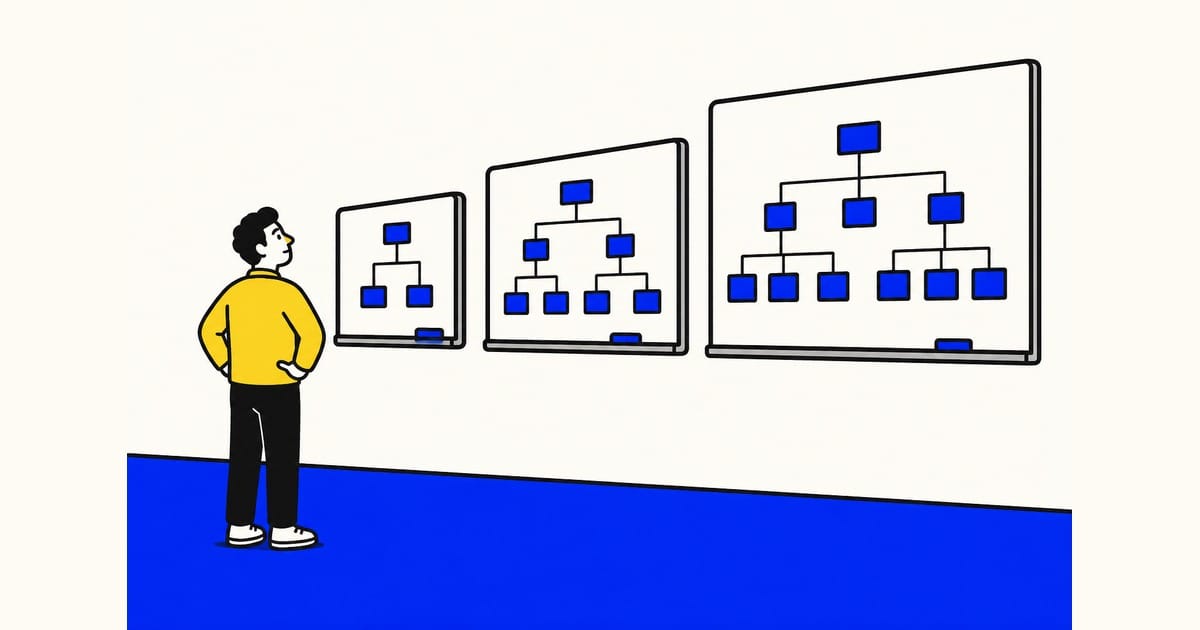

Transparent leadership means sharing the reasoning behind decisions — not every piece of information you have, but enough that the people around you can evaluate whether the reasoning makes sense. The leaders who do this consistently build faster, more durable trust than the ones who manage information carefully. The ones who manage information carefully spend that trust without knowing it.
When I bought out the Embarc exec team
In 2001, after the dotcom bust hit our digital agency hard, I bought out the executive team at Embarc. The remaining staff had watched senior people leave. Revenue was down. The pipeline was thin. Nobody knew what came next, and I had to decide what to tell them.
I told them the truth. We had maybe six months of runway if we held the line on costs. The pipeline I was working had no guarantees. I did not know if we were going to make it. What I did know was that I was going to try to reposition the business rather than wind it down, and that anyone who stayed was betting on that alongside me.
Some people left immediately. The ones who stayed became the core of what we rebuilt. We repositioned Embarc into Boston's biotech and pharma sector — a market that turned out to be relatively insulated from the dotcom collapse — built a repeatable delivery methodology, and eventually sold to a firm in Philadelphia that gave us access to their client base.
The honest conversation at the lowest point was the first step in all of that. Not because honesty is a virtue in the abstract. Because it gave the people who stayed a clear picture of reality, and that clarity let them make a real choice. The ones who chose to stay were all in. That is a different kind of team than the one that stays because it does not know what is actually happening.
What the information gap actually costs
Most leaders who have transparency problems are not lying. They are managing information — softening bad news, delaying difficult conversations, presenting more certainty than they actually have. They do it because it feels like protection. It protects the team from anxiety. It protects the leader from hard questions.
The problem is that the people around a leader are smart. They can sense the gap between what they are being told and what is actually happening. The gap itself is the problem. A team that knows revenue is down and hears from leadership that things are fine learns, quickly, that leadership cannot be trusted. The bad news would have been easier to absorb than the gap.
I have watched this pattern in fractional engagements more times than I can count. A company brings in outside help because something is not working. In the first few weeks, you learn that the real problem has been known internally for some time. People saw it. Nobody said it out loud in a way that required a response. The cost is not just the delay. It is every decision made in the wrong direction during that time — resources spent, roadmap priorities set, hires made, all of it compounding on a problem that could have been addressed earlier.
The practice
Transparent leadership in practice looks like this: before any significant decision, make explicit what you know, what you are assuming, and what you are uncertain about. This takes about two minutes. It changes the quality of the conversation that follows because it forces everyone in the room to engage with the actual state of the situation rather than the version that has been prepared for them.
It also models something durable. Teams take their cues from how their leader handles uncertainty. If you project false confidence when you do not have it, they learn to project false confidence. If you name what you do not know, they learn it is safe to do the same — and you start getting better information from them in return. That feedback loop compounds.
This is related to but different from Radical Candor, Kim Scott's framework for direct interpersonal feedback. Radical Candor addresses how a leader communicates with individuals - the combination of caring personally and challenging directly. What I am describing here operates at a different level: what a leader shares with the organization about the state of the business, what is known, what is uncertain, and what is being done about it. Both matter. They are not the same practice.
The directly responsible individual model works on the same principle: every task has an owner whose name is attached to it. Accountability visibility without surveillance. The structure itself creates transparency without requiring a leader to remember to be transparent in every individual interaction.
Why the best people need this most
The highest-performing people on any team are the most sensitive to the information gap. They are the ones who can sense it earliest and who have the most options when they decide they do not trust the picture they are being given. A managed-information environment does not affect everyone equally. It accelerates attrition of exactly the people you cannot afford to lose.
The leaders who told me the truth when things were hard were the ones I worked hardest for. Not because I valued honesty in the abstract. Because it meant I could trust everything else they told me. That trust is the actual asset. Everything else follows from it.