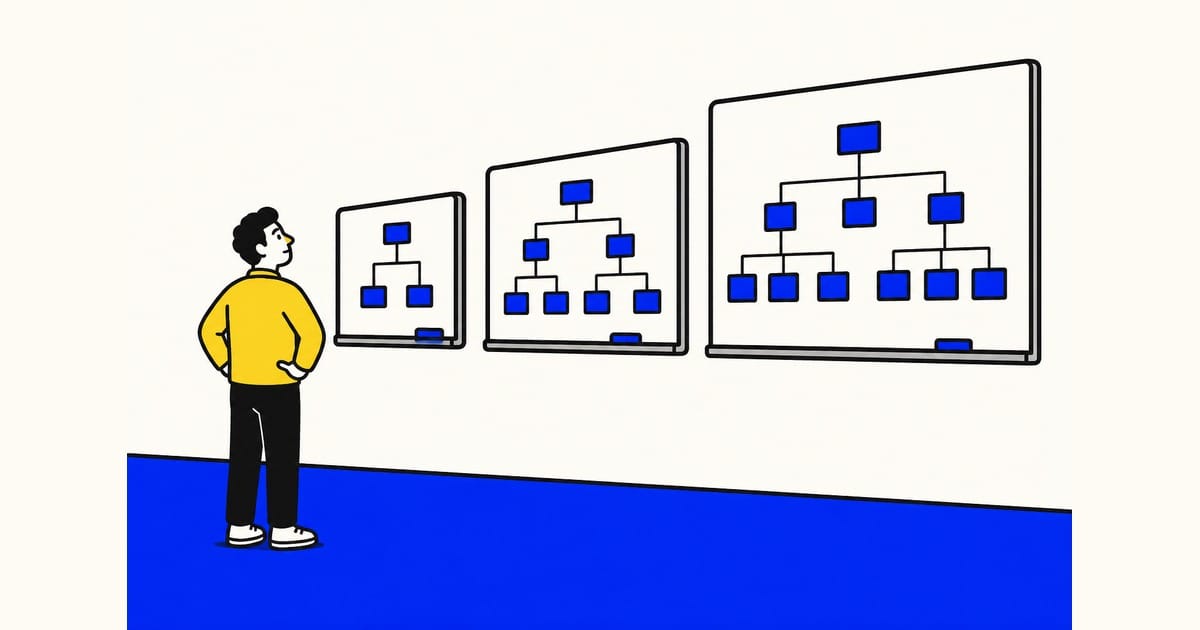

The product owner vs product manager question has a simpler answer than the internet suggests. A product owner is an accountability defined by Scrum, held by one person for one team's backlog. A product manager is a job, with a scope, a level, and a number attached. The 2020 Scrum Guide never uses the words product manager, which is why these two titles have been arguing past each other for twenty years.
I have started at more than a dozen companies as a fractional product leader. Some version of this question comes up early at most of them. It never arrives as a definitions question. It arrives as an org chart with two boxes and a fight about which box a decision lives in. Teams get this wrong by splitting one accountability across two people, then acting surprised when nobody can say no.
What is the difference between a product owner and a product manager?
A product owner is a Scrum accountability. A product manager is a job. The Scrum Guide is specific about the first one. It names a single person, not a committee, accountable for maximizing the value of the product that comes out of the Scrum team's work. It puts the product backlog in that person's hands. It says nothing about roadmaps, pricing, positioning, or P&L. Scrum is a delivery framework. It was never trying to describe a career.
That is the whole origin of the confusion. One title came out of a software delivery framework written in the 1990s. The other came out of the job market. Melissa Perri has been making this point since 2017 and it still has not fully landed. Product owner is a role you play on a team. Product manager is a job you hold at a company. Most product managers are also the product owner for their team. That is one person, wearing the label the framework needs when they walk into sprint planning. The same collapse happens between product management and project management, usually among people who have only seen the job from the outside.
| Question | Product owner | Product manager |
|---|---|---|
| Where the title comes from | The Scrum Guide | The job market |
| What it names | An accountability inside one Scrum team | A job with a scope and a level |
| Primary artifact | The product backlog | The strategy and the outcome it should produce |
| Who assigns it | The structure of the Scrum team | The company org chart |
| What breaks without it | Scrum stops working as defined | Nobody owns the outcome |
This stops being a vocabulary problem the moment a company hires for both, separately, and gives them different managers.
Is a product owner higher than a product manager?
Neither one is higher. They sit on different axes, so ranking them is a category error. The pay data does diverge. Product manager roles in the US cluster around $131,000. Product owner roles cluster closer to $110,000. That gap reflects the seniority mix of who takes each title rather than a rung on a ladder.
The hiring pattern across engagements is consistent. Companies that post a product owner requisition are usually buying backlog throughput on a product that already exists. Companies that post a product manager requisition are usually buying an outcome they cannot yet describe. The top of both bands pays about the same. The problems are nothing alike. If you are working out which one you are, the product management career ladder tells you more than the title on the requisition does.
Splitting strategy from the backlog divides the accountability, and accountability does not survive being cut in half.
What splitting the roles across two people actually costs
Splitting strategy from the backlog divides the accountability. SAFe formalized this split at scale. It places a product manager at the value stream level, above five to twelve product owners at the team level. Practitioners have criticized it for years on exactly this point. The strategic half owns the why with no control over what ships. The tactical half owns what ships with no authority over the why. Both halves can do their jobs correctly while the product goes nowhere.
I ran product for the hotels business at TripAdvisor inside a matrix. There was a head of product per vertical, sitting on top of a shared platform. That structure holds up. The split runs along the customer problem, and each vertical lead holds the full decision for their surface. What falls apart is slicing one product's decision rights horizontally. Now the person who sets direction and the person who orders the backlog are two people, with two managers and two sets of incentives. Misaligned incentives surface as a communication problem months before anyone names them as a structural one.
Teams with the split often ship plenty. What breaks is subtler. The backlog stops expressing the strategy and becomes a negotiation between two managers. At that point the roadmap is fiction. The tell is easy to spot from outside. Ask what changed in the backlog after the last strategy review. If the answer is a reprioritization that landed three weeks later, after several meetings, the split is already costing you.
What to look for when you hire for either role
The product owner vs product manager choice shows up most concretely in hiring. Hire against the decision you want made, not the title you want filled. The two requisitions attract different people, and the screen should look different too.
For a product owner, the signal is judgment under a fixed constraint. The team has a sprint. The list is longer than the sprint. Ask a candidate to walk you through the last thing they cut and who was unhappy about it. Strong candidates name the person. Weak candidates describe a process. The job lives in the tradeoff, so a candidate who has never made an unpopular one has never really done it.
For a product manager, the signal is whether they can describe an outcome that did not happen. Ask what they shipped that failed, and what they believed at the time that turned out to be wrong. I ran hotel metasearch at TripAdvisor and I ran Instant Booking, and Instant Booking is the more useful story of the two. Building something to $200 million in eighteen months teaches you less than watching a bet you were confident about fail to change customer behavior. Candidates who only carry wins have not been close enough to the outcome to own it.
The overlap matters more than the difference. Both roles need someone who can hold a position in a room full of people who outrank them. Neither role works when the person is a scribe for other people's decisions.
How to decide whether you need one person or two
Start from decision rights, not headcount. The test is simple. Name the single person who can kill a feature that engineering has already started building. If two names come up, or the honest answer is that it would go to a meeting, the accountability is already split. The fix is to stop splitting it.
Two people is right in a narrow set of cases. Sometimes one product spans enough surface that no individual can hold both the market context and the daily backlog. That usually shows up when a single product line runs across more than three or four delivery teams. A product manager over several product owners is reasonable there. It only works if the product owners report through product. When they report through engineering or a program office, the title is doing organizational work that your software development team structure should be doing instead. The product owner becomes a ticket writer with a product title.
One person is right far more often than the org design conversation assumes. In a marketplace the binding constraint is usually liquidity. Someone who does not sit in the backlog every day cannot feel where matching breaks. I ran product at EnergySage, a clean energy marketplace, and at TripAdvisor across hotel metasearch and Instant Booking. In marketplace work, the distance between the strategy and the backlog is the thing that kills you. Agile transformation programs are where the split usually gets introduced. It usually arrives as a template rather than as an answer to a scaling problem anyone actually had.
There is a version of this argument worth having. It is about how much context one person can carry before the product suffers. That number is real, and it is smaller than most executives want it to be. The mistake is answering it with a second title instead of a second team.
Companies that post a product owner requisition are usually buying backlog throughput. Companies that post a product manager requisition are usually buying an outcome they cannot yet describe.
Product owner vs product manager is downstream of a question most companies have never answered out loud. Who is allowed to decide what does not get built. Answer that first and the org chart writes itself. Answer it second and you will spend a year arguing about job descriptions while the backlog quietly becomes the strategy.