
A marketplace business model is defined by the unit the marketplace charges for: a click, a completed transaction, or a qualified lead. Each unit puts the conversion risk on a different party. Cost per click leaves it with the supplier, a commission moves it onto the marketplace, and a lead fee splits it at the handoff. Pick the unit by asking which side can see the sale close and which side can make it close.
I have built two marketplace business models on the same TripAdvisor traffic, and the one that grew faster is the one that got turned down.
At TripAdvisor I ran hotel metasearch, a cost-per-click business that cleared more than $100 million. Hotels and online travel agencies bid for the click, the traveler left for the partner's site, and TripAdvisor was paid whether or not anyone booked. Then I spent three years building Instant Booking, where the traveler booked without leaving TripAdvisor and the hotel paid a commission on the completed reservation. Instant Booking went from $0 to $200 million in 18 months. In May 2017, Skift reported that TripAdvisor had dramatically downplayed it in favor of the more lucrative metasearch option.
I can explain that reversal better now than I could from inside it. We changed what TripAdvisor charged for, and the change moved the conversion risk onto our side of the table.
What is a marketplace business model?
A marketplace business model is the rule for what a marketplace charges for and who pays. The three common units are a click sent to a supplier, a commission on a completed transaction, and a fee for a qualified lead. The unit decides who absorbs the loss when a buyer shows interest and then does not buy.
Most explainers that rank for this term list six or seven models, from commission to subscription to listing fees, and treat the choice as a pricing menu. I read it as a decision about risk. Every marketplace sells a probability. A traveler on a hotel page might book. A driver comparing insurance quotes might buy a policy. A homeowner asking about solar might sign a contract. Somebody has to absorb the cases that do not convert, and the unit you charge for picks who that is.
The three units I have run side by side:
| Unit the marketplace charges for | Who carries the conversion risk | What the marketplace has to own | Where I ran it |
|---|---|---|---|
| Click (cost per click) | The supplier | Ranking and the quality of the traffic it sends | TripAdvisor hotel metasearch |
| Completed transaction (commission) | The marketplace | Checkout, bookable inventory, and every failure before payment | TripAdvisor Instant Booking |
| Qualified lead (lead fee) | Split: the marketplace on qualification, the supplier on the close | Lead quality and the quality of the supply that receives it | EverQuote, EnergySage, Rhino Eco |
How does a cost-per-click marketplace make money?
A cost-per-click marketplace sells buyer intent one click at a time and leaves the close to the supplier. It gets paid the moment the buyer leaves, so its whole job is sending clicks that are worth paying for.
In hotel metasearch that meant an auction. Partners bid for the click on a given hotel and night, and TripAdvisor decided which offers to show and in what order. If the partner's booking page was slow, or the price on it did not match the price on ours, the partner lost the booking and TripAdvisor kept the click revenue. That is why the fight I described in marketplace pricing strategy was a fight about the partner's landing page. Under cost per click, the page where the sale happens belongs to somebody else.
The model rewards what TripAdvisor was already good at. It had enormous research traffic and the trust of travelers who had read the reviews. The $100 million in metasearch came from improving the match between traveler intent and hotel inventory, so the right traveler saw the right offer at the right moment and the click was worth more to both sides. The cost is that the marketplace owns nothing after the click. The booking, the confirmation email, and the next trip all go home with the supplier.
Why is a commission model the riskiest marketplace revenue model?
A commission model only pays when the transaction completes, so the marketplace owns every failure between interest and payment. In exchange it owns the buyer relationship and the data from the whole funnel.
Instant Booking moved TripAdvisor into that position. The hotel paid only for completed bookings. In November 2014, PhocusWire reported that booking-engine sources expected the commission auctions to start at a 12 percent minimum with a 15 percent cap for mid-tier chains. The same piece cited a Cowen estimate that hotels paid an effective 13 percent of booking value through cost-per-click metasearch, and about 15 percent for a guest arriving through Booking.com.
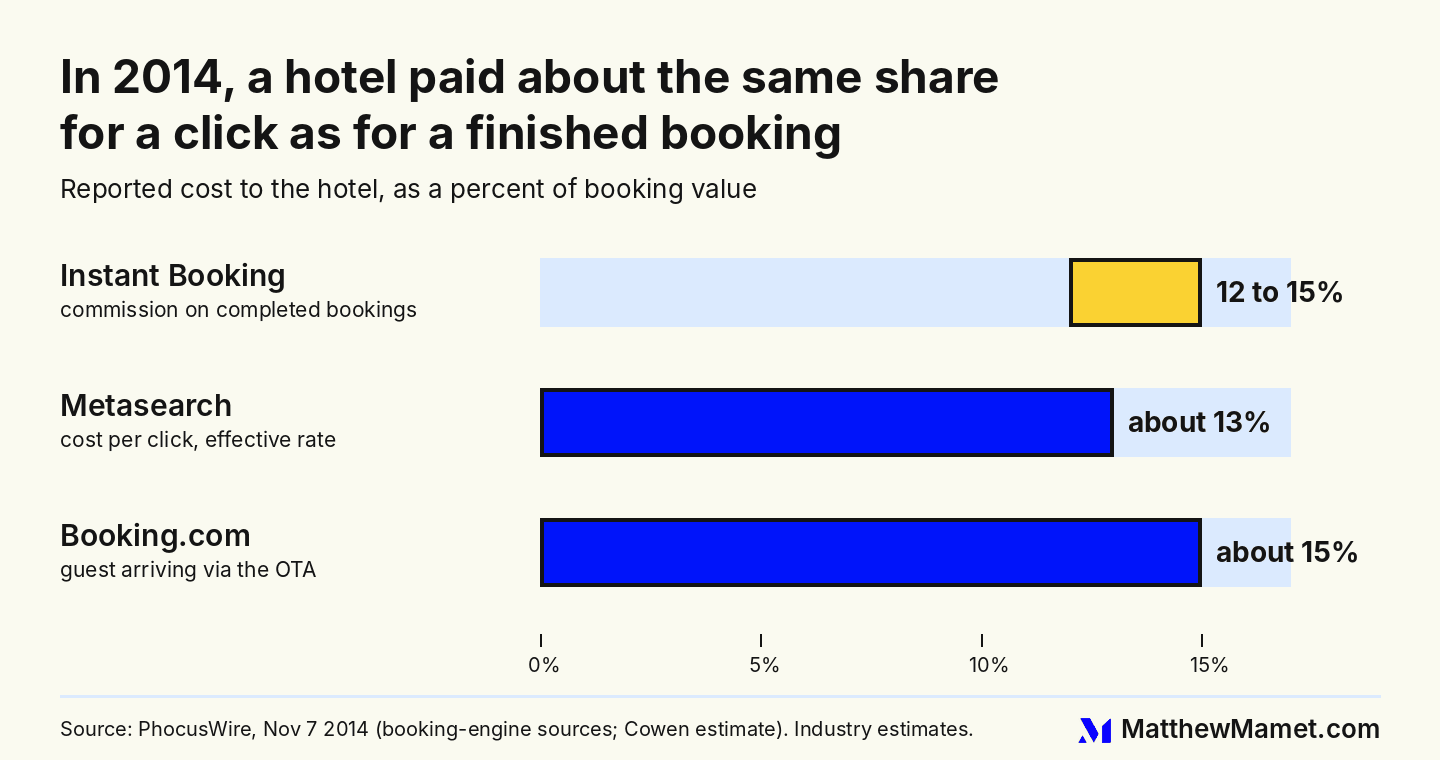
Put next to each other, those numbers show the trade. A hotel paid roughly the same share of the booking under either model. Under cost per click, the hotel carried the risk that a click did not turn into a stay. Under Instant Booking, TripAdvisor carried it, and to make bookings complete it had to grow the supply of bookable inventory, improve matching, and keep cutting checkout friction until conversion beat the redirect. That work is how we got to $200 million, and I wrote up the build in the Instant Booking story. The model asked TripAdvisor to win at checkout, against companies whose entire business was checkout.
Commission pays the marketplace that controls the close. If your advantage ends at the click, charge for the click.
Skift attributed the 2017 reversal to competition, with Trivago and Google gaining in metasearch. I would add the business model to that list. TripAdvisor's advantage was research traffic and trust, and both pay off at the moment of the click. Commission earns its keep when the marketplace can run the transaction better than the supplier can, which is the position Booking.com built over decades.
When does a lead fee marketplace business model work?
A lead fee works when the sale closes off the platform, over days or weeks, through a person the marketplace cannot replace. The marketplace carries the risk that the lead is real and well matched. The supplier carries the risk of the close.
EverQuote is the clearest example I have worked inside. Its annual report says it derives revenue principally from consumer inquiries sold as referrals to insurance providers, in the form of clicks, data and calls. An insurance policy is quoted, underwritten and bound by the carrier or the agent, and a marketplace has no business trying to run that sale. So EverQuote's north star was qualified lead volume rather than total lead volume, and the work was matching shopper intent to what each carrier wanted to buy. That focus carried through the expansion out of auto into more insurance verticals, which took the business from $200 million to $400 million.
The lead fee has its own failure mode, and it sits on the supply side. A lead's value is set by whether the supplier closes it, and the marketplace does not control that step. At EnergySage, installers would not pay to be on the platform without qualified homeowners, and homeowners would not engage without credible installers. At Rhino Eco, a solar marketplace, homeowner interest was high but too many weak installers sat in the network, and cancellations after first contact climbed with them. A good lead handed to a weak supplier reads as a bad lead to everyone involved. That is why the fix there, covered in marketplace growth strategies, was tightening supply before buying more demand.
A lead fee is a promise about the close that the marketplace cannot keep by itself.
How do you choose a marketplace business model?
Charge at the last step you control. Three questions get you there, and I ask them before anyone debates a take rate.
First, can you see the transaction complete? If the purchase happens on your page, you can. If it happens on a carrier's quote system or in a homeowner's meeting with an installer, you cannot, and a commission would mean billing against a number you have to take on trust. Second, can you change whether it completes? Seeing the checkout is different from running it. A marketplace can track conversion on a partner's page and still have no say over how that page loads or what price it shows. Third, how long does it take from interest to purchase? A hotel booking happens in one session. An insurance policy or a solar contract can take weeks, with a human in the middle.
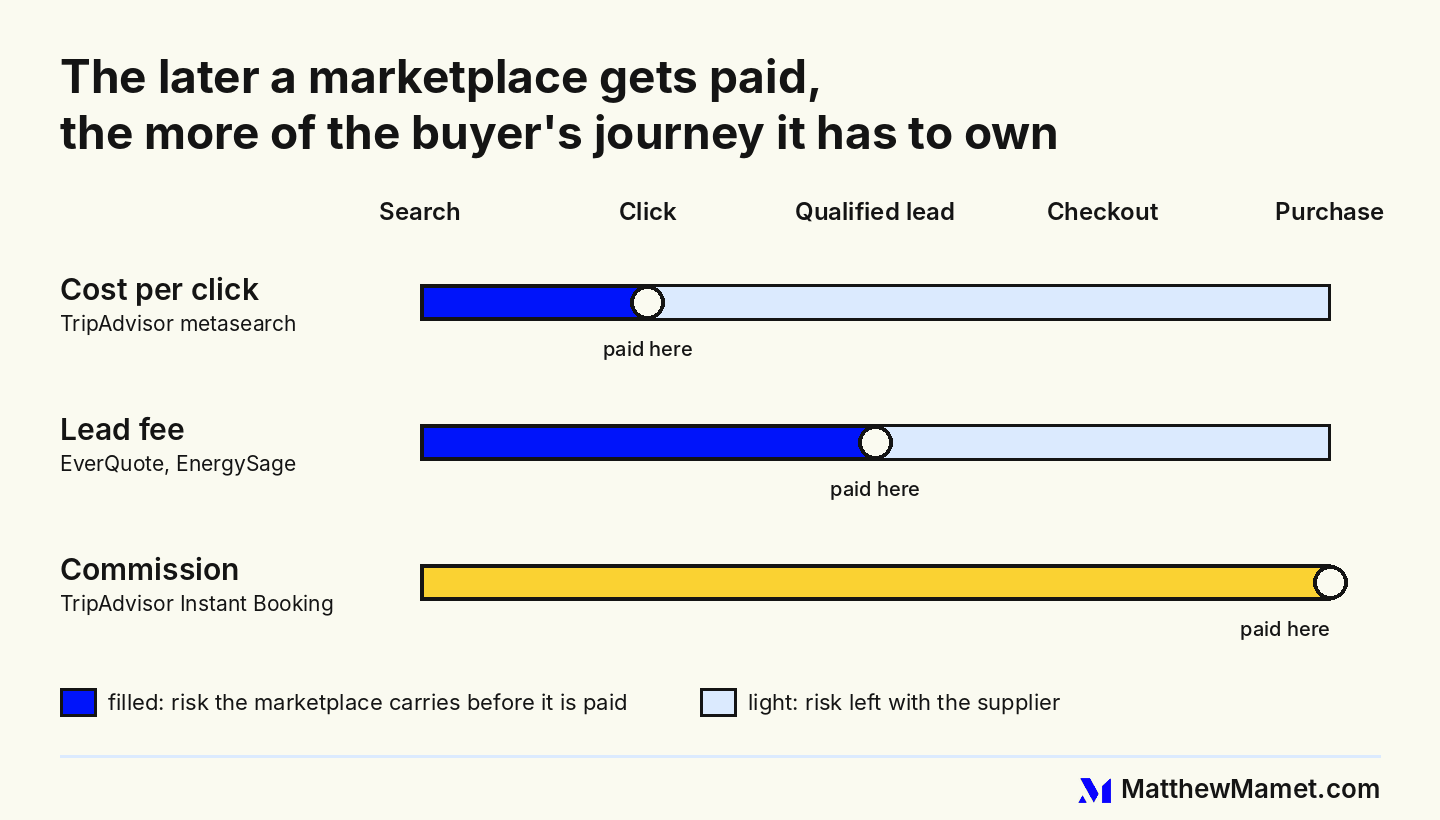
When you can see the close, change it, and it happens in one sitting, commission fits and the upside is real. When you can see the close but cannot change it, charge for the click and spend your effort on the quality of what you send. When you cannot see the close at all, or it takes weeks and a person, charge for the lead and invest in the supply that receives it. Before picking, find out where matches stall today; the method I use is in how I use AI to diagnose marketplace liquidity. The question gets sharper as AI agents take over the comparing, because an agent that completes the purchase moves the click, the last step a comparison site controls, out of the comparison site's hands.
Instant Booking taught me that the faster-growing marketplace business model can still be the wrong unit. TripAdvisor's traffic was worth the most at the moment of the click, and the model that charged there is the one the company kept.