

Hotel metasearch is a listings marketplace: it collects every price for one hotel on one set of dates, ranks the offers, and sells the click to whichever partner the traveler picks. Solar quote marketplaces run on the same mechanics with a longer sale. In both, the marketplace sells the comparison, and the comparison only works when the offers on the page are true and can be compared.
In June 2013, TripAdvisor finished rolling out hotel metasearch to every market. On the next earnings call the company said, as PhocusWire reported, click volume on priced hotel links was down about three times and conversion was up about three times. I joined TripAdvisor that month, and for the next six months my job was rolling hotel metasearch out worldwide and optimizing its performance. Those six months are where I learned A/B test-driven optimization at global scale. In December I moved to a new project.
Years later I was CPO at EnergySage, a solar marketplace where a homeowner asks for quotes and installers send them in. Hotels and rooftops have almost nothing in common. The mechanics underneath were the same, and so were the ways they broke.
How does hotel metasearch work?
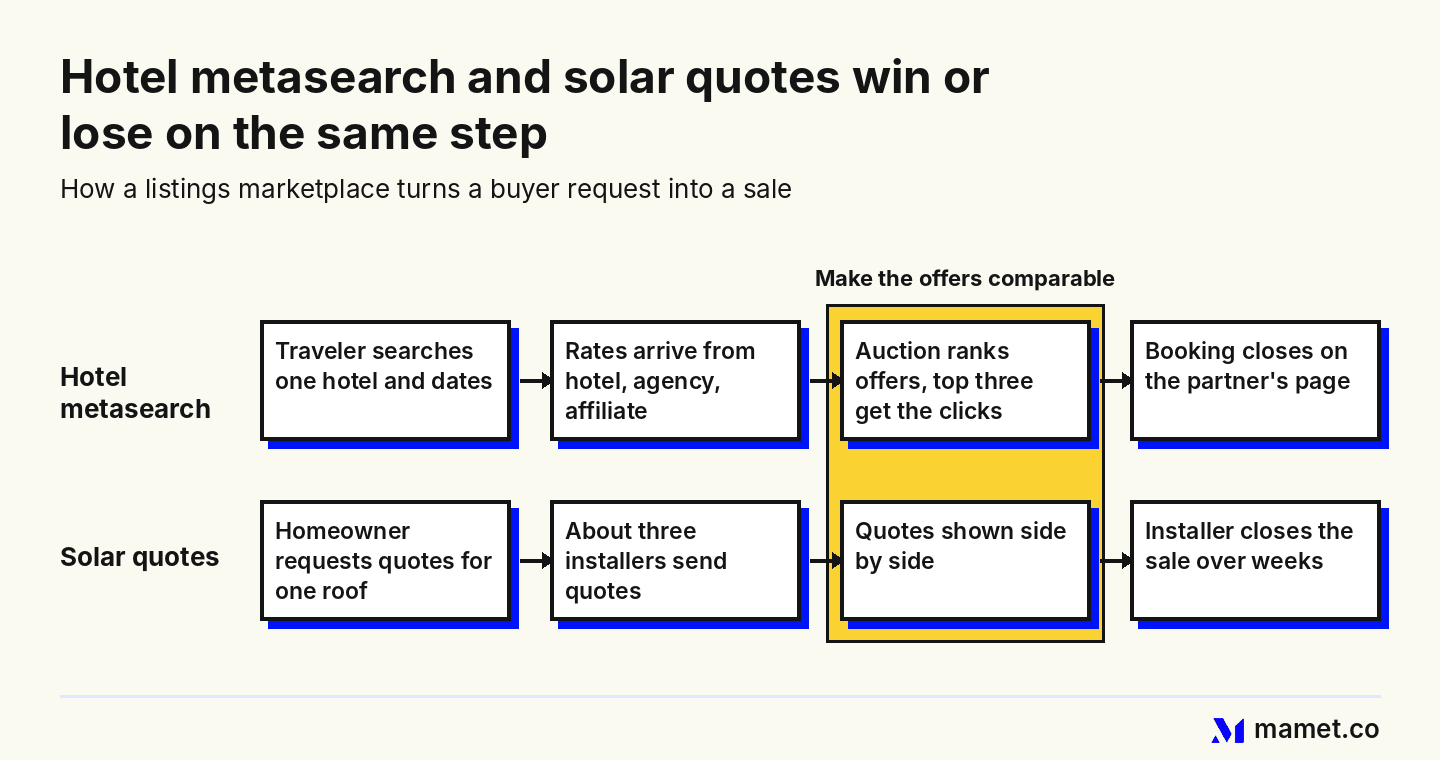
Hotel metasearch works by showing every available price for the same room on the same night side by side and selling the click on each price. The traveler searches a hotel and dates, the site pulls live rates from every partner that carries the room, orders them, and charges the partner whose link gets clicked.
The rates arrive by more than one road. At TripAdvisor a single property could show up through its own direct connection, through an online travel agency, and through an affiliate network sourcing from that same agency. Three routes, one room, three ways of handling taxes and fees. The page had to reconcile all three in the half second before it painted, and then decide which ones a traveler saw first.
A solar quote marketplace does the same job in slow motion. On EnergySage a homeowner sets up a project, and the company says about three installers typically submit quotes within a week. The homeowner compares them side by side and picks one. The structure is the same: a buyer request, competing offers, a page that lines them up, and a sale that closes somewhere else.
| Listings marketplace mechanic | Hotel metasearch at TripAdvisor | Solar quotes at EnergySage |
|---|---|---|
| What the buyer asks for | One hotel, one set of dates | Quotes for one roof |
| Who supplies the offers | The hotel, travel agencies and affiliate feeds | Pre-screened local installers |
| How offers reach the page | Live rates, ranked by an auction | Quotes submitted by installers, shown side by side |
| Who pays the marketplace | The partner, per click | The installer, a participation fee |
| Where the sale closes | On the partner's booking page, in one session | With the installer, over weeks |
| What breaks the comparison | A price that changes after the click | Quotes built on different assumptions |
The last row is where both businesses are won or lost. The marketplace does not make the hotel room or install the panels. Its whole product is the moment a buyer compares, and that moment is only worth something if the comparison is accurate. How each one charges is a separate choice, covered in the marketplace business model as a choice about who carries the conversion risk.
How does the hotel metasearch auction decide who ranks first?
The auction ranks on expected value: roughly the bid multiplied by the odds that the click turns into a booking. A metasearch site earns money only when a link gets clicked, so it wants the offer most likely to be clicked and booked, priced at the bid that makes that click worth the most. A high bid on a bad price loses to a fair bid on a good one.
Google says this out loud. Its documentation for hotel ads says ranking comes from an auction that considers partner bids and the quality of the ad, and names the accuracy of the partner's prices as one of the quality factors. A rate that is wrong when the traveler lands burns the traveler's trust in the comparison, and the comparison is the only thing the site sells.
Position is worth far more than the bid gap suggests. On the same 2013 call, TripAdvisor told investors that positions four and below get a tiny fraction of the clicks and encouraged partners to bid into the top three slots. The first three offers split most of the traffic, and everyone below them is paying to be listed.
The ranking is also where the money was during my six months. That A/B test-driven optimization added $100 million in incremental revenue. It worked by improving the match between traveler intent and hotel inventory, so the right traveler saw the right offer at the right moment and the click was worth more to both sides. Hotel partners got a better return on their bids, and the auction paid TripAdvisor for the improvement.
Why do the offers on a listings page have to be comparable?
The offers have to be comparable because the buyer acts on the ranking, and a ranking of mismatched offers sends the buyer to the wrong one. Hotel metasearch and solar quotes fail this test in opposite directions, and the fix in both lives upstream of the page.
At TripAdvisor the failure was a price that changed. A traveler would see $189 on our page, click through, and land on a booking page reading $214. Same hotel, same room, same night. Sometimes taxes and fees were handled differently on the partner's side, sometimes the rate had moved since the last cache refresh, and sometimes an affiliate feed was carrying a room that had already sold. The partner lost the booking and TripAdvisor kept the click revenue. I wrote that up as a lesson in marketplace pricing strategy.
A listings marketplace sells the comparison. When the offers on the page are not comparable, it is selling a guess.
At EnergySage the failure was quotes that were never alike to begin with. Installers quote different system sizes, different panel brands, different inverters, different warranty terms, and different assumptions about a roof they have all looked at. Put four of those side by side and the cheapest number wins, and the cheapest number is usually the smallest system. Making the quotes comparable before showing them was the product. EnergySage now runs every quote on its marketplace through a fixed set of assumptions, including the same electricity bill data, a standardized rate increase and the same panel degradation rate, so a homeowner is comparing installers rather than spreadsheets.
Why do hotels overpay for metasearch?
Hotels overpay for metasearch because they bid against travel agencies for travelers who are already looking at their hotel, and then carry every click that does not book. The traveler on a hotel's metasearch page has picked the property. The auction is about who collects the booking, and the hotel is paying to win back a guest who was coming anyway.
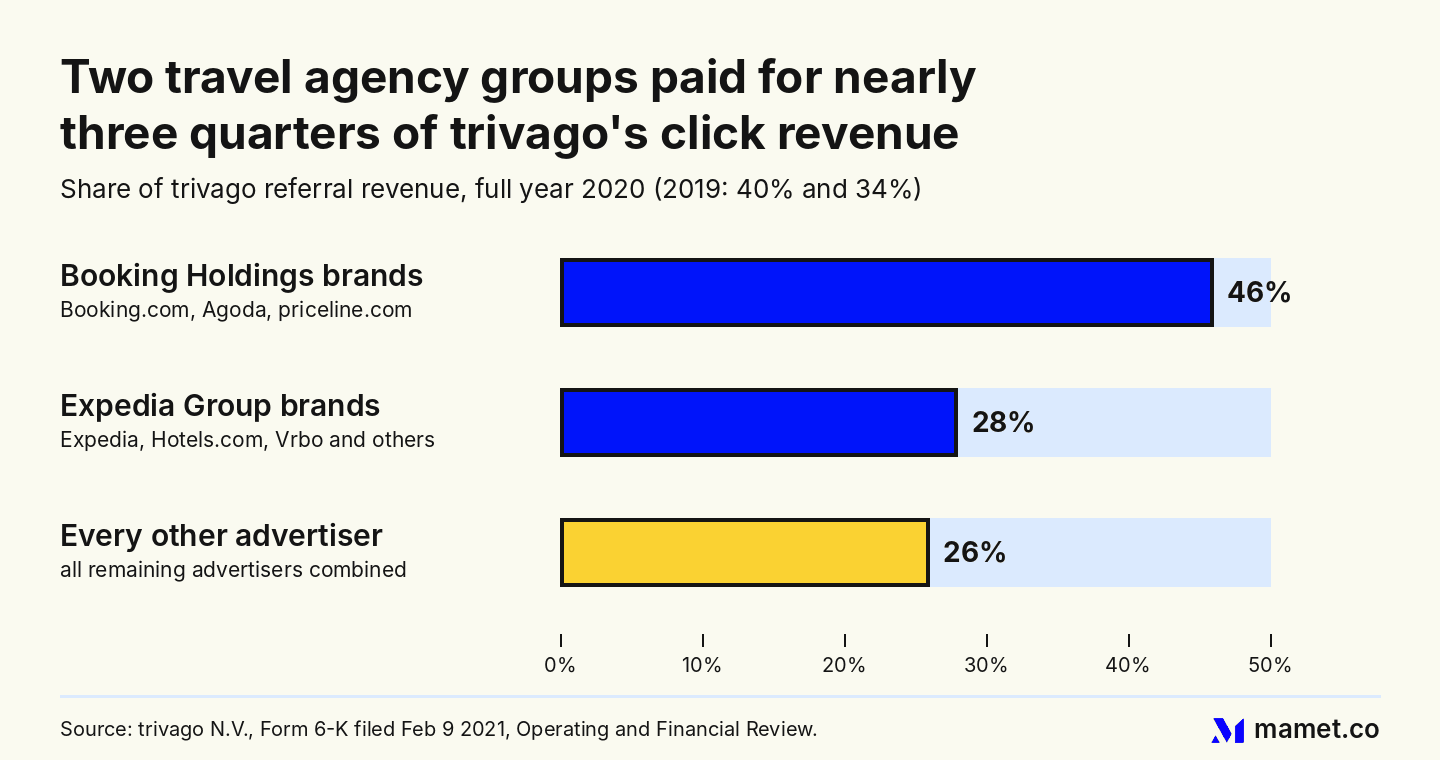
The bidders on the other side of that auction are few and large. In 2013, Expedia and Priceline together made up nearly half of TripAdvisor's revenue. Trivago's 2020 filing shows the same concentration from another metasearch site: brands affiliated with Booking Holdings produced 46 percent of its referral revenue that year and Expedia Group brands 28 percent. In 2019 the split was 40 and 34 percent, the same three quarters. An independent hotel bidding on its own name is outnumbered on its own page.
The price paid is close to what the agency would have charged. A 2014 PhocusWire report cited a Cowen estimate that hotels paid an effective 13 percent of booking value through cost-per-click metasearch, against about 15 percent for a guest arriving through Booking.com. Two points of margin, bought with all of the conversion risk.
What should a listings marketplace own, and what should the supplier own?
The marketplace owns comparability and the supplier owns the close. A metasearch site or a quote marketplace has to make the offers on its page true and alike, because that is the product. The hotel or the installer has to win the buyer once they arrive, because the marketplace cannot.
For a hotel, that means treating metasearch as a test of its own booking page before treating it as a media buy. Check that the price on the metasearch page is the price on the booking page, with taxes and fees handled the same way, on the dates people actually search. Then check how fast the page loads and whether the room the traveler clicked is the room they land on. Only then does the bid become the lever, and the bid that matters is the one that reaches the top three slots on the dates the hotel most needs to fill.
For an installer on a quote marketplace, the same discipline applies to the quote. A quote that wins on price by shrinking the system will lose the homeowner later, and the marketplace takes the blame along with the installer. I covered why weak supply hurts a marketplace more than thin supply in marketplace growth strategies.
AI assistants are starting to do the comparing for the buyer, and EnergySage released an AI-enabled instant quoting feature in 2024. I looked at what that does to comparison sites in what happens when AI agents replace the comparison step. An agent reads the same offers a person does, only faster, so a marketplace whose offers are true and alike is in a better position whichever system ends up choosing.
Six months of optimizing metasearch at global scale and a stretch running a solar marketplace taught me the same thing from two directions. A listings marketplace is paid for the moment a buyer chooses. It keeps getting paid only if the offer the buyer chose is still true when they act on it.