A high-performance team gets built by deploying strengths on purpose, not by coaching weaknesses up to average. Work out what each person is unusually good at and what quietly drains them, then compose roles so one person's blind spot is another person's default setting. The strongest teams I have run were never the most talented on paper. They were the best assembled.
I have started at nine or ten companies now, and the same waste shows up at every one. Managers pour their best energy into the thing a person is worst at. The performance review is built around it. The whole ritual assumes a great teammate is a well-rounded one, so everyone spends the year sanding down their rough edges. That instinct is backwards, and it is expensive.
When I was the full-time CPO at EnergySage, my actual job for a stretch was building the product org from the parts on hand and the people I could hire. The tempting move is to clone yourself, because your own strengths feel like the definition of good. I made myself resist that. The point of a team is not five copies of the same operator. It is coverage.
Why does trying to fix weaknesses waste your time?
Because you spend your scarcest resource, attention, moving someone from bad to tolerable at a thing they will never love. Meanwhile the work they are genuinely great at gets no oxygen.
Picture a product manager who is phenomenal at customer discovery. She can sit in a messy problem space for a week and come out with the one insight nobody else saw. She is also loose on timelines and lets the tracking slide. The reflex is to send her to a time-management course and grade her down at review time. I have watched that play out and it changes nothing, because the looseness is the tax you pay for the discovery talent. You do not fix that with a course. You pair her with a project-minded partner who takes real pleasure in the tracking she hates. Give her that and her output stops being throttled by her weakest muscle. This is a structure problem wearing a performance-problem costume, which is also why misaligned incentives so often get blamed on individual people.
How do you actually map strengths across a team?
You look past the skills on the resume to the energy underneath them - what lights someone up and what flattens them by 3pm - and you write that down next to their role. Skills tell you what someone can do. Energy tells you what they will still be doing well in month nine.
At EnergySage I ran this quietly as I hired. For each role I was less interested in the checklist of competencies and more interested in the one or two things a person did without being asked, the work they gravitated to on a slow afternoon. Someone who reorganizes a backlog for fun is a different hire than someone who lights up in a customer call, and both are gold if you place them right. The tool you use to surface this barely matters. Gallup, a plain self-report, a thirty-minute conversation about what drained them at their last job - they all work, because the value is in forcing the conversation and making the strengths visible. It takes ego out of the room. It turns hiring into deliberate composition instead of collecting the most impressive individuals you can afford.
A group of B-players with clear ownership and honest feedback will beat a group of A-players who avoid the hard conversations, every time.
That is the part people miss. Composition matters, but the process wrapped around it matters more. The best teams I have been part of were not the most talented ones. They were the most honest about what was working and what was not, and the fastest to change it. If you want the mechanics of how the seats fit together, I get into it in how you structure product squads.
What does a deliberately composed team look like under real pressure?
It looks like a group where the strengths were chosen to match the fight, not the org chart. The clearest version I lived through was at Acquia, where the competitive picture forced the issue.
Acquia sells an enterprise digital experience platform, and the strategy leaned into product-led growth. That put us in a two-front war at the same time. Upmarket we were up against Adobe and Sitecore, where the buyer is a committee, the sales cycle is long, and the whole motion is about trust and scale. On the other flank were Contentful and Prismic, developer-first tools where a single engineer picks you on a Tuesday because the docs are good and you get out of their way. You cannot fight both of those with one kind of person. A team of enterprise veterans would have been deaf to the bottoms-up developer motion. A team of developer-native product people would have fumbled the buying committee. The composition had to be deliberate: people who understood the weight of an enterprise deal sitting next to people who understood why a developer adopts something in an afternoon, and enough trust between them that neither side treated the other as the enemy. That is casting, not a checklist.
You see the same logic underneath the whole fractional CPO pattern, which is most of what I do now across five or so client engagements. I am almost never dropped into a team that lacks talent. I am dropped into one where the talent is aimed at the wrong things, where two strong people are quietly competing for the same slice of the work because nobody drew the lines. The fix is rarely a new hire. It is a recomposition of who owns what.
How do complementary strengths actually pair up?
They pair by putting each person's natural strength next to the exact gap it tends to open. The point is to design for the fit ahead of time, not to patch weaknesses in a panic once they surface.
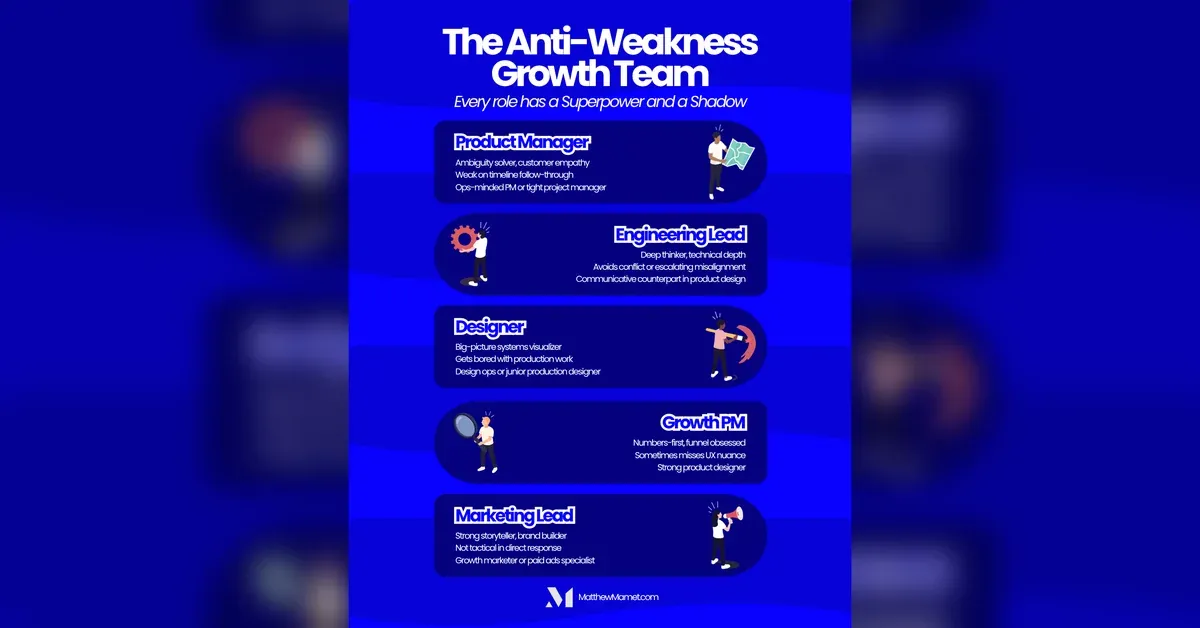
Here is the shape I sketch when I sit with a leadership or cross-functional team and map where the strengths and the frayed edges are.
| Role | Natural strength | Where it frays | Team complement |
|---|---|---|---|
| Product Manager | Ambiguity solver, deep customer empathy | Loose on timeline follow-through | An ops-minded PM or a tight project manager |
| Engineering Lead | Technical depth, careful thinker | Avoids conflict, lets misalignment sit | A high-communication counterpart in product or design |
| Designer | Big-picture systems visualizer | Loses interest in production polish | Design ops or a strong production designer |
| Growth PM | Numbers-first, funnel obsessed | Skates past the UX nuance | A product designer who guards the experience |
| Marketing Lead | Storyteller, brand builder | Weak on tactical direct response | A growth or paid-acquisition specialist |
Read across any row and the same move repeats. You are pairing a dominant strength with the specific complement that lets it run at full speed without wrecking anything.
When should you lean into dominance instead of balance?
When the phase of work demands it. A team you balance perfectly for one stage will drag in the next, so build teams you can rebalance rather than teams you have to tear down.
Early product discovery wants imbalance on purpose. You want the divergent thinkers, the people comfortable living in chaos, the ones who cross disciplines without asking permission. Load that room with careful maintainers and they will suffocate it before it produces anything. But once you have something worth scaling, the dominance flips. Now you need the systems thinkers and the precise operators who ship it clean and keep it up. The mistake is treating the roster as fixed. The best org designers I have worked with treat teams as modular, something you recompose as the problem changes, which is also how sustainable marketplace growth got built at TripAdvisor. This is the same muscle as shaping supply and demand in a product org: you are matching the shape of the team to the shape of the work in front of it.
When people get to operate in a zone of strength, a few things unlock fast and at once. They move quicker because there is less internal friction. They do deeper work because the work energizes them instead of grinding them down. And they collaborate more freely, because they trust that the person next to them has the blind spot covered. That trust is the real output. It is the difference between a team that hesitates over who owns what and a team that just moves.
So the next time something is not clicking, resist the question everyone reaches for first. Do not ask what is wrong with the person. Ask what they are unusually strong at, and whether you have built the team around that strength or against it. Great teams are not the ones where every part is perfect. They are the ones where the parts were chosen to fit.