Sunsetting a product means deliberately demoting, selling or ending it on a stated date, with a plan for its customers, its revenue and its team. The announcement is the easy part. The hard part is the decision, and it gets easier when the exit terms were written before launch: which number ends the product, when you read it, and who can make the call.
I once owned the rebrand of PermissionTV to VisibleGains, including the site relaunch and the choice of CMS, all against a fixed product launch date. PermissionTV built an online video platform for premium content owners, with clients including Fox, MGM and The Metropolitan Museum of Art. The product was real and the problem was real. The company wound down anyway.
I spent that quarter on what the company would be called. The question I care about now sits underneath that work: what number would have told us to stop, and who would have read it?
When should you consider sunsetting a product?
Consider sunsetting a product when it loses to the company's next-best use of the same money and people, measured by a number the whole company answers to. A product's own revenue cannot show you this. A product can grow every quarter and still make the business worse, so the test has to sit one level above the product.
Zillow Offers is the cleanest public case. On November 2, 2021, Zillow said it would exit the business of buying and flipping homes. CNBC reported Offers revenue of $1.17 billion that quarter, up from $185.9 million a year earlier. The homes segment, which was mostly Offers, lost $421.6 million in the same quarter, and Zillow cut 25 percent of its workforce. Rich Barton gave the reason plainly: "Continuing to scale Zillow Offers would result in too much earnings and balance-sheet volatility."
Revenue grew more than sixfold in a year, and the company-level number still said stop.
The number can also be time. At PermissionTV, every sales conversation started from scratch, because the buyers had no shorthand and no budget line for the category. I have written about what that does to a sales cycle: it doubles, the cost of each deal climbs, and the go-to-market runs too slowly for the capital available. No product dashboard reports that. It shows up in the distance between the months of cash you have and the months the market needs.
Two more questions belong next to the company-level number. Who would complain if the product disappeared next month? A team that cannot name those customers is running the product on inertia. And what would this team build if it were free tomorrow? If nobody can name the next-best project, the company has no comparison to make, and the sunset conversation will stall on sentiment. Answer that one first, because the case for ending a product is always a case for doing something else with the people.
Why should the terms for sunsetting a product exist before launch?
Write the terms before launch because launch is the last moment the people in the room have nothing to protect. Eighteen months later there is a team, a roadmap, a revenue line and a story the company has told investors. Each of those is a reason to read the next number kindly.
A rebrand adds to that pile. A new name, a new site and a launch date on the calendar are all commitments to continue, and each one makes the next soft quarter easier to explain. Choosing one number a room will accept is hard enough when nobody's job depends on the answer. Choosing it after the job does is close to impossible.
The method is three lines on the launch document. The first is the number that ends the product, and it has to be a company-level number, because a product-level number will defend the product. The second is the date you read it, set far enough out to survive the launch curve. The third is the one person who can make the call. If two names come up, or the answer is that it would go to a meeting, you have no owner, which is the same test as who can kill a feature.
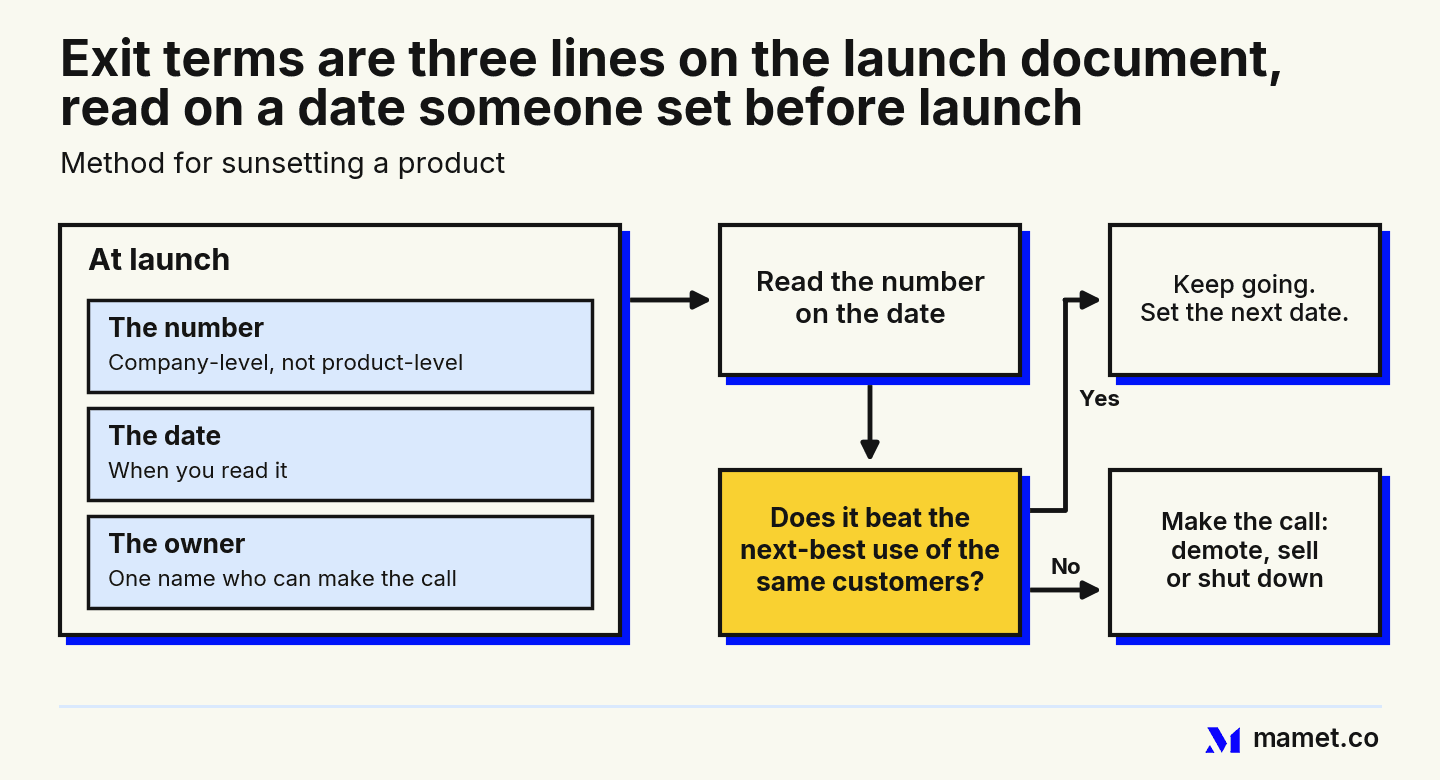
Applied to PermissionTV, with what I know now, the first line would read: if the sales cycle has not shortened by this date, at this burn, we stop selling the category. A pre-mortem would name that risk. The exit terms say what you will do when the risk arrives.
The terms also need a room where they get read. The quarterly operating review I defined with BetterLesson's CEO gave each of six teams a seven-minute walkthrough and thirteen minutes of discussion. A date on a launch document does nothing unless it lands on a meeting like that one, with the person who owns the call in the chair.
What are the ways to sunset a product?
There are three ways to sunset a product: demote it, sell it, or shut it down. Each one fits a different finding. Shutdown gets most of the attention, and for a product with real revenue it is one option of three.
| Exit | What happens to the product | When it fits | Example |
|---|---|---|---|
| Demote | Stays live, loses its primary placement | Some customers still prefer it, but it loses to a better unit for most | TripAdvisor Instant Booking |
| Sell | Keeps running under a new owner | The product is healthy and the owners want different things from it | EditMe, sold to Wakefly |
| Shut down | Ends on a published date | Nobody should own it, and customers can move elsewhere | Zillow Offers, 2021; Google Stadia, 2023 |
Demotion keeps an option open, at the cost of keeping the code and the support burden on the books. I worked on one: Skift reported that Instant Booking had been "dramatically downplayed" in favor of metasearch, after it reached $200 million in 18 months. A demoted product still needs an owner who is willing to say what it is for.
Selling is the one operators forget. I co-founded EditMe with Matt Wiseley, and we bootstrapped it to about 5,000 customers at $5 a month. Matt wanted to run a self-sustaining business. I wanted to raise and compete against PBwiki. The Wakefly conversation resolved that for both of us. A sale gives customers a continuing product and gives the founders an ending. Before you plan a shutdown, ask whether the product would be a good business for someone with a different cost structure or a different appetite for risk.
Shutting down needs the most care. Google announced on September 29, 2022 that Stadia would stay playable through January 18, 2023, about three and a half months later. It refunded hardware bought through the Google Store and game and add-on purchases made through the Stadia store. Its stated reason was short: Stadia "hasn't gained the traction with users that we expected." It also named where the technology was going next: YouTube, Google Play and its augmented reality work. The next-best use, said out loud in the same announcement.
How do you sunset a product without losing customers?
Sunset a product without losing customers by giving them the date, the replacement and the path for their data before you give the market your reasoning. Customers can plan around a date. They cannot plan around your strategy memo.
Most guides on this topic center on the communication plan, and the plan matters. The order is what they tend to skip. Close new sign-ups first, so the problem stops growing. Call the largest accounts personally before anything goes out in writing. Publish one date and hold it, because a date that moves teaches customers to wait you out. Give them a working migration before you turn anything off. Then write down what happens to the revenue, so nobody discovers the hole in next quarter's forecast.
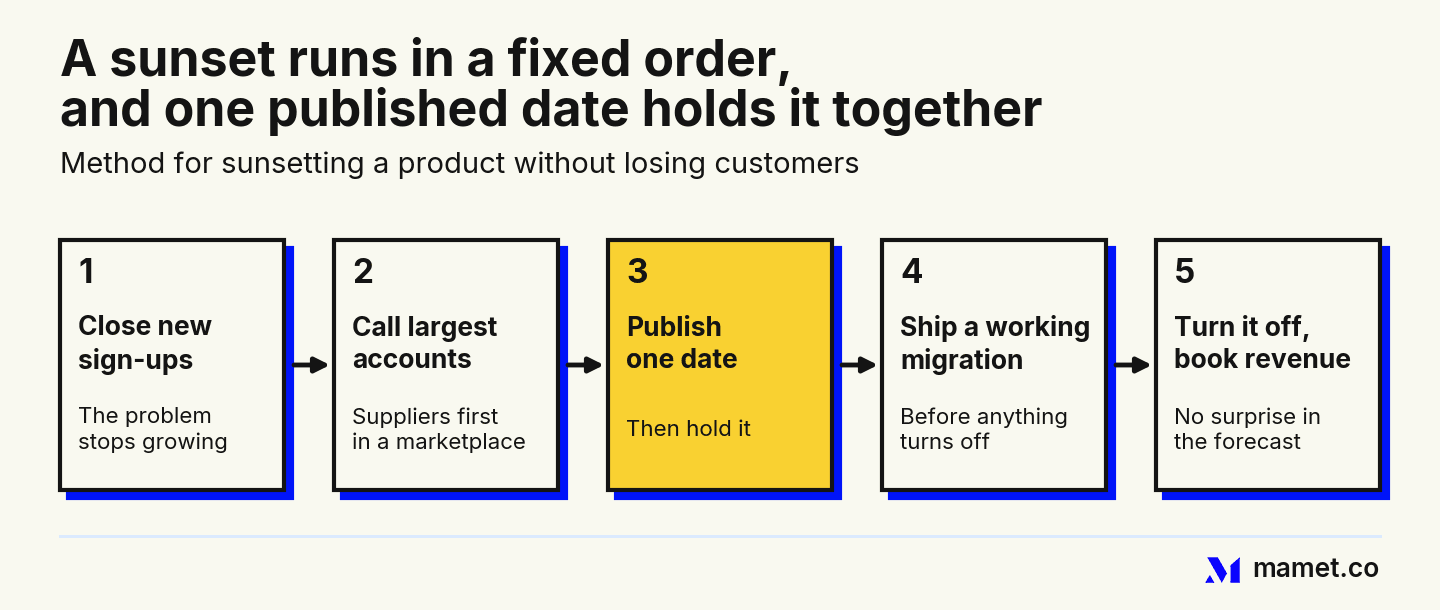
A marketplace has this problem twice. Suppliers built around you too, and any supplier who changed how they work for your product deserves a call before they read about the change in the trade press. Sequence the supply side first, since a supplier who leaves early breaks the product for the customers who are still on it.
Then there is the team. Tell the people who built the product what happens to them before you tell anyone else, and name their next work in the same conversation. They know the customers and the failure modes better than anyone, and they will run the migration if they trust what comes after it.
A product can hit every number on its own dashboard and still lose to the company's next-best use of the same money and people.
I once spent a quarter on what a company would be called. I would trade part of it for one page, written before launch, when everyone in the room still believed and agreeing to an ending cost nothing.