
MEDVi's business model is to rent the clinic and buy the customer. Doctors, pharmacies and shipping come from white-label telehealth platforms, and customers come from affiliates paid a published $200 to $325 for each purchase. A new customer on the entry product pays $149 to $179 in the first month, so every sale starts behind and pays back when the $299 second-month charge clears.
Most people met MEDVi on April 2, in a New York Times profile that made it sound like the first one-person company scaled by AI. The affiliate network listings tell a different story.
I ran a fifty million dollar media budget at Spark Networks across five dating brands. Before that I spent years at EverQuote and EnergySage, on the side of the table that supplies the customer. From either seat, the number that explains MEDVi is the price it pays for a customer, and the day that price comes due.
Why is MEDVi so popular right now?
MEDVi is popular because the New York Times presented it as the first proof of Sam Altman's prediction that one person with AI would build a billion-dollar company. The numbers were built to travel: $20,000 to start, two employees, $401 million in 2025 sales and a projected $1.8 billion for 2026.
Altman made the prediction in 2024. The Times profile ran on April 2, 2026, said the paper had been given access to MEDVi's financials, and described founder Matthew Gallagher building the company from Los Angeles with ChatGPT, Claude, Grok, Midjourney and Runway. Forbes ran its own version the same day, and the AI newsletters followed within the week.
Two details got lost in the retelling. The $1.8 billion is projected sales. MEDVi has raised no outside money, so nobody has put a valuation on it. And the two employees, Gallagher and his brother, work with contract engineers, account managers and outside agencies. Gallagher assembled this company from rented parts, and the part that made it grow is the one AI had the least to do with.
What is MEDVi's business model?
MEDVi sells compounded GLP-1 weight-loss drugs on a monthly subscription and outsources almost everything except the offer. It rents the medical operation, runs the storefront with AI tools and contractors, and pays affiliates for each customer who buys. Only the third of those is hard to copy, and it is hard because it is expensive.
Drug Discovery and Development's account of the Times profile lays out the first two layers. CareValidate, a telehealth-in-a-box platform, and OpenLoop Health handle the doctors, pharmacies, shipping and compliance. AI tools wrote the code, the copy and the ads. Then there is where the customers come from. Steven Tey summarized it on X: relationships with more than 10,000 affiliates and top-tier commissions, "up to $500/lead vs $75 by competitors."
| Layer | Who does the work | What MEDVi pays for it |
|---|---|---|
| Supply: clinicians, pharmacy, shipping, compliance | CareValidate and OpenLoop Health | Platform and fulfillment fees, not public |
| Storefront: site, copy, ads, support | Two employees, contractors and AI tools | Software subscriptions and contract labor |
| Demand: the customer | Affiliates and ad platforms | A published $200 to $325 per purchase |
The first two rows are for sale to anyone at market price. A direct competitor, Remedy Meds, runs on OpenLoop too. So the edge has to sit in the third row. In the terms I used for who carries the conversion risk in a marketplace business model, MEDVi pays on a completed purchase. The affiliate carries the risk up to the sale. MEDVi carries everything after it.
How much does MEDVi pay for a customer?
More than the customer pays in the first month. The affiliate listings are public, and I read them next to the price list.
Katalys lists a default MEDVi commission of $228 to $235 on purchases, with VIP rates case by case for quality traffic. Xentraffic lists $260 with weekly payouts. Vexio lists $325, and a RevOffers listing on Affplus shows $200. Smaller networks list $105 to $210. Tey's $500 ceiling fits the VIP tier. On the other side of the ledger, a price tracker that checked MEDVi's site on October 17 shows the compounded semaglutide injection at $149 or $179 for the first month and $299 a month after that.
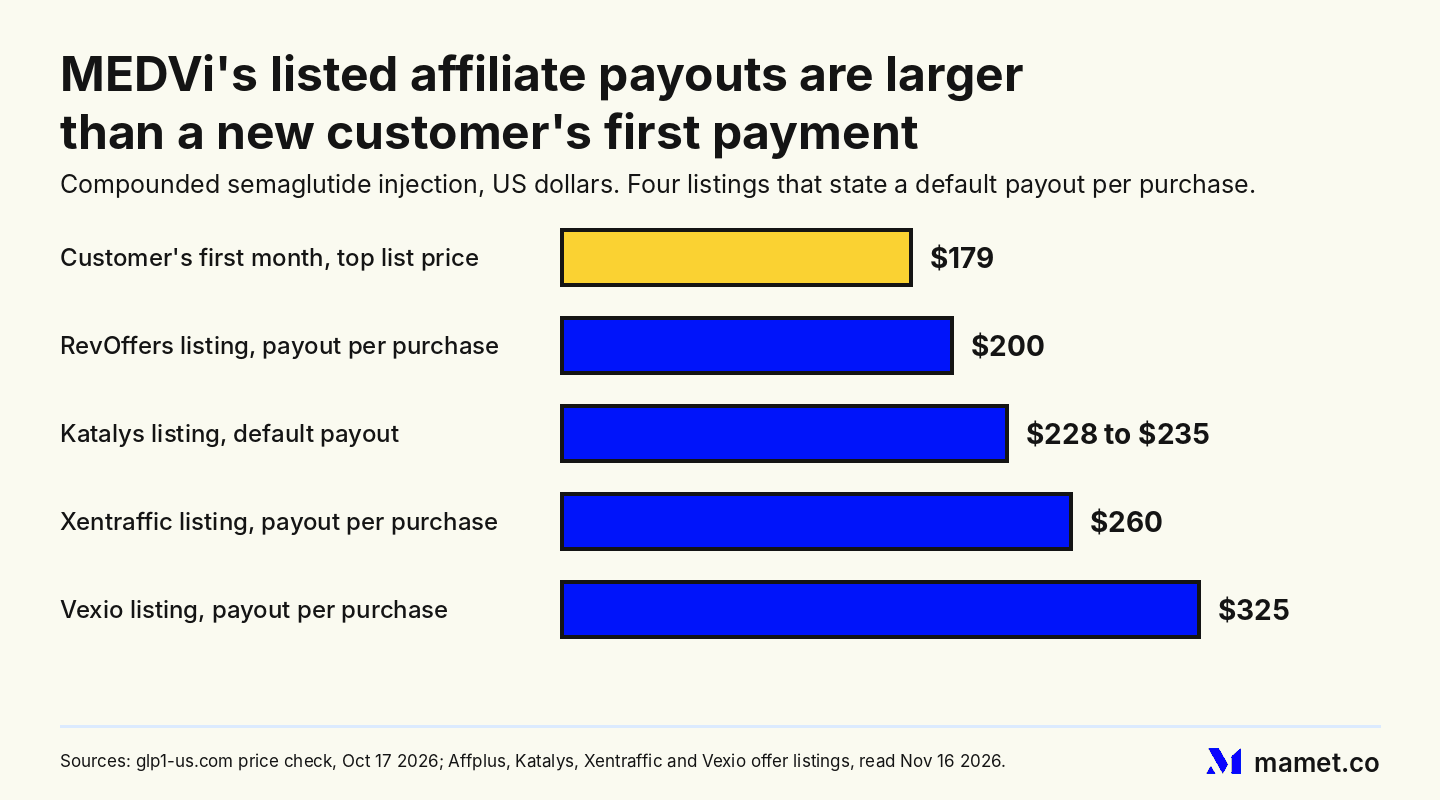
At the Katalys default rate and the $179 price, MEDVi is about $50 behind on day one. At $325 and $149 it is $176 behind. Both figures come before the drug, the clinician, the shipping and the card fee.
An affiliate is a business with its own media bill. It sends the next customer to the offer that pays the most per sale and converts well enough to collect. EverQuote's annual report says it earns its revenue from consumer inquiries sold as referrals to insurance providers, and the work there was matching shopper intent to what each carrier wanted to buy. MEDVi sits where the carrier sits. It decided to be the buyer every seller of GLP-1 demand wanted first, and it set the price to get there. I wrote about the paid acquisition trap from five years of marketplace filings. That study found rising spend buying less growth each year. MEDVi's version works only while the second charge keeps clearing.
Why does MEDVi's second month decide whether it makes money?
MEDVi pays for a customer in the first week and earns the money back at the second charge. The gap between those two dates is the business.
The clearest public view of the timing is a lawsuit. In December 2025 an affiliate partner called The Offer sued MEDVi in Los Angeles Superior Court, and Brendan Keeler read the filings closely. The two signed an insertion order in September 2024, the month MEDVi launched, for a fee per acquisition. The Offer says it drove tens of millions of dollars a month in revenue to MEDVi, and that MEDVi paid every invoice on time for about a year. The two invoices in dispute are dated September 1 and September 8, 2025: $845,205 and $216,330, one week apart.
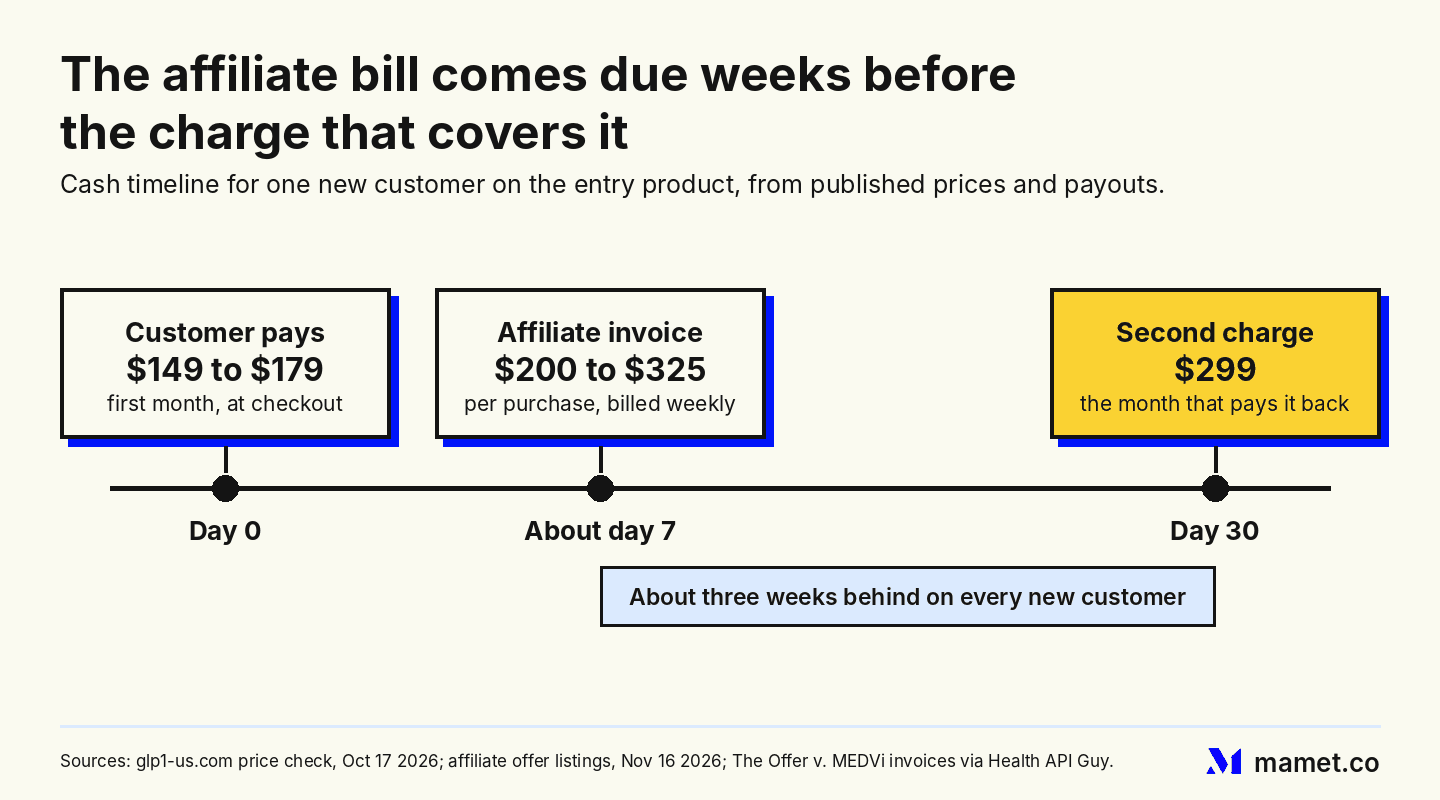
Put the dates in order. The customer pays $149 to $179 at checkout. The affiliate's bill for $200 to $325 arrives within about a week. The $299 charge that puts the account ahead lands on day 30. A company that started with $20,000 and took no outside capital has one place to fund that gap: customers who stay.
Every customer who cancels before the second charge is a customer MEDVi paid to lose.
The first payment says the ad worked. The renewal says the business works. That holds for any subscription bought with paid traffic, which is what I ran at Spark Networks, and it is the reason performance marketing arbitrage ends badly for brands whose customers do not come back. MEDVi has not published its second-month retention. The Times says it was given access to the financials to verify revenue and profit, so the bet has been paying.
What does buying customers through affiliates cost MEDVi?
It costs control over how the customer was sold, and it leaves MEDVi answering for the method. A fee per purchase buys the outcome and is silent on how the seller got there.
On February 20, 2026, six weeks before the Times profile, the FDA sent a warning letter for misbranding. It said the site suggested MEDVi compounded the drugs it sold, and that lines such as "Same active ingredient as Wegovy® and Ozempic®" implied FDA evaluation. MEDVi's April 8 statement says the site named in the letter belonged to an affiliate marketing agency and that MEDVi never received a letter. Drug Discovery and Development points out that the letter is addressed to MEDVi, LLC. Business Insider found Meta ads for MEDVi running under doctor profiles that do not appear to exist, many tied to affiliates, and Gallagher told the outlet that "maybe 30%" of its advertising runs through them. A class action filed March 20 in California alleges that affiliates send spoofed spam email on MEDVi's behalf. Those are allegations, and MEDVi disputes the FDA's attribution.
I have seen the same failure from the opposite direction. At Rhino Eco, a solar marketplace, too many weak installers sat in the network and cancellations climbed with them. The fix, covered in marketplace growth strategies, was tightening supply before buying more demand. At MEDVi the questions are about the party that sends the customer.
Rented demand has a second cost. In August 2025 Remedy Meds acquired The Offer, which by then held a year of MEDVi's traffic and conversion data. According to the filings, MEDVi stopped paying and pulled The Offer's tracking pixels. Gallagher told the court that MEDVi "has the funds to pay the due balance but chooses not to," and in March the judge granted right-to-attach orders against MEDVi and against Gallagher personally, who had guaranteed the payments.
MEDVi's largest known supplier of customers now belongs to a competitor, and it left with the conversion data.
What should operators take from MEDVi?
Take the cash timeline, and leave the headcount. The AI layer is real and anyone can buy it for the price of a few subscriptions, which is why it explains so little. An AI product manager who manages the system that does the work can run a storefront with two people. The same tools are available to every competitor on the same platforms.
What MEDVi had was a founder willing to outbid everyone for the customer and a product whose second month held often enough to cover the bid. Three numbers test any business built this way: what you pay for a customer, what the customer pays first, and how many days sit between your bill and your payback. If the middle number is smaller than the first, you are in the retention business, whatever the pitch deck says.
None of this is a moat. The clinic is rented, the storefront is software anyone can buy, and the customers go to whoever pays the most this week. MEDVi's lead lasts as long as it can outbid the field and keep the second month. A competitor with more capital can take both.
AI took the cost of running a telehealth storefront close to zero. It did nothing to the price of a customer, and MEDVi won by paying more of it than anyone else.