Scaling product management across time zones comes down to redesigning the operating model for asynchrony, not stretching a co-located one across the map. Distributed product teams ship well when decisions get written down with a timestamp, when one person owns each product area outright, and when the two or three overlap hours a day get spent on the arguments that actually need a live voice. The tooling is the easy part. The design is the hard part.
I ran product for a single vertical inside TripAdvisor's shared platform, and my team was never in one building. Engineers in one geography, design in another, me and a chunk of the PM group somewhere else again. Hotel metasearch on its own was a hundred-million-dollar-plus business, and the work of coordinating it never fit inside a nine-to-five in any one city. I have started at nine or ten companies since, most of them distributed by default, and the pattern holds every time. The teams that struggle are not the ones with bad people or bad tools. They are the ones running a co-located playbook a few thousand miles too wide.
Why do distributed product teams stall even when everyone is working hard?
They stall because the co-located rituals - the standup, the hallway decision, the sprint ceremony - all assume everyone was in the same room, and none of them survive a nine-hour gap. Effort is rarely the problem. Latency is.
Instant Booking is the cleanest example I have. We took it from zero to two hundred million in about eighteen months, and it was a genuine cross-team effort - metasearch, the booking flow, supply, and engineering all pulling from different offices on different clocks. The velocity came from clarity, not from everyone being awake at the same moment. Here is the honest other half. Instant Booking later stalled. Some of that was market and strategy, but part of it was coordination decay. As the effort spread wider and the org grew, the crisp ownership that carried the early sprints got fuzzy, and decisions started waiting on rooms that never quite assembled. A distributed team does not fail on day one. It fails slowly, one deferred decision at a time, until a launch that should take a week takes a month and nobody can point to who stopped it. The structure that held up best for us was a VP of product per vertical inside the shared platform. Each vertical carried its own outcomes and its own team, so the person accountable for a number was also the person who could move without begging a central group for a slot. When accountability and authority sit in the same seat, a nine-hour gap is an inconvenience. When they sit in different time zones, it is a wall.
How do you keep context from getting lost between time zones?
Treat context transfer as a real job, not a side effect of talking. The failure mode in remote product work is not that people drop the ball. It is that they pick up the wrong one and run a mile before anyone corrects them.
Across the US and Europe, the thing that kept my TripAdvisor teams tight was writing down what was still open before logging off. Not the polished decision - the unresolved part. The assumption still being tested, the question waiting on data, the call that had not been made yet. That single habit gave the next time zone a running start instead of a cold read. The other rule I hold to is that a decision does not exist until it is written somewhere with a name and a date attached. A choice made verbally in an overlap call is a choice half the team never heard. When you spread that discipline across the org, the person in the later time zone stops guessing and starts building. Speed in a distributed org is a downstream effect of clarity, not a substitute for it.
The other thing I lean on hard is voice and video over long documents. If a spec cannot be explained in a short recorded walkthrough - the use case, the trade-off, the thing you are unsure about, said out loud - it is usually not ready to hand off. A ten-page doc dropped on an engineer who has never met the PM and works eight hours ahead is a slow-motion misunderstanding. Three minutes of someone talking through the intent lands in a way the doc never will, and the engineer can watch it when their day starts instead of waiting for yours.
The best product managers in a multi-time-zone org are not the fastest repliers. They are the clearest writers.
Should you organize distributed teams by function or by time zone?
By time zone, whenever the work lets you. Split a squad by function across oceans - PMs in one place, design in another, engineering in a third - and you spend half your energy syncing instead of shipping.
At EverQuote the expansion out of auto into new insurance verticals added roughly two hundred million in incremental revenue on top of the existing two hundred, and it only worked because each vertical had a clear owner and a team that could move without waiting on a central group parked three time zones away. That is the general shape of it. Keep the people who need to argue daily inside a workable overlap, and push the coordination out to the seams between teams rather than through the middle of one. When two people share a product area across an ocean, name one as the directly responsible individual for execution and let the other feed strategy. Shared ownership across a gap creates friction, not magic. How you draw the product org structure matters more when the org is distributed, because every fault line in the chart turns into a handoff that costs a full day.
Which hours actually matter when your team spans continents?
The two or three where everyone is awake. Treat them like the most expensive real estate you own and spend them only on the work that dies without a live voice.
Real-time debate, hard trade-offs, the messy strategic argument where you need to read the room - that is what overlap hours are for. Status updates, one-on-one check-ins, spec walkthroughs, and anything that can be written down should never touch that window. The mistake I see most is filling the golden hours with reporting, then wondering why the genuinely hard calls keep slipping another day. Protect the overlap. Guard it against the reflex to schedule a meeting for something a paragraph would have settled. And instead of booking a call for every choice, set a deadline for input. Say the feedback is due by a specific hour in a shared time zone, then move. Most product calls are reversible anyway, which is why I treat so many of them as two-way doors rather than reasons to convene the whole team at an ugly hour.
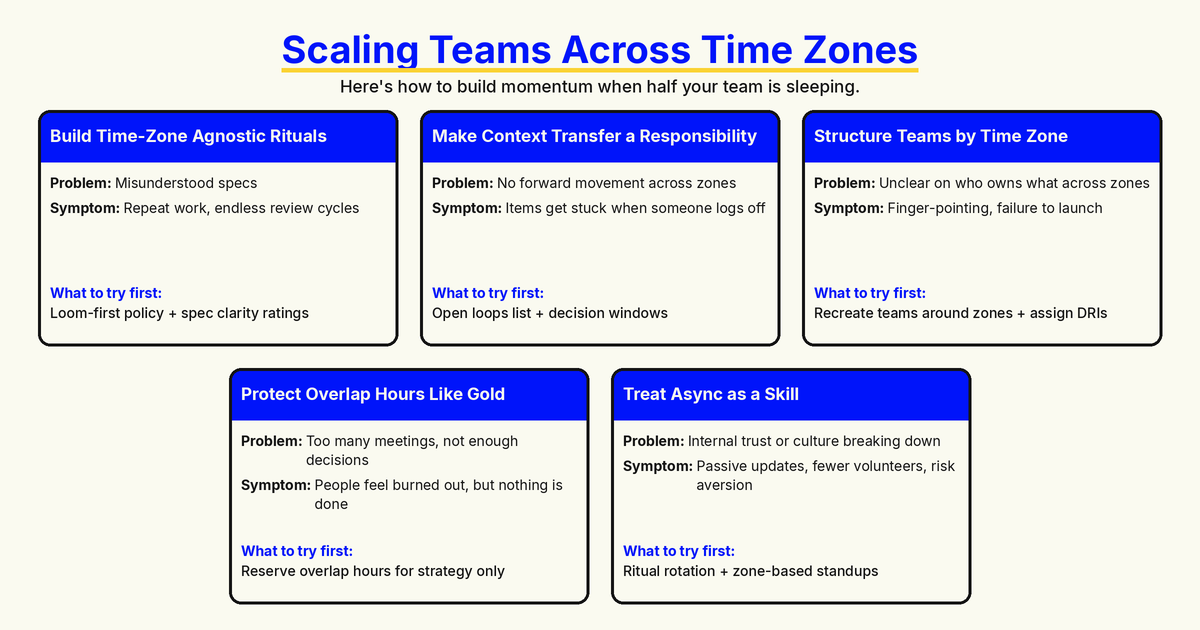
Here is how I map the common failure to the first move that actually fixes it, rather than reaching for another recurring meeting.
| What is breaking | How it shows up | First move |
|---|---|---|
| Misread specs | Repeat work, endless review loops | Explain it out loud on video before it ships |
| Work stalls across zones | Items freeze the moment someone logs off | Write an open-loops note at end of day |
| Too many meetings, too few decisions | People are tired but nothing moved | Reserve overlap hours for strategy only |
| Nobody knows who owns what | Finger-pointing, failure to launch | Name one owner per area and write it down |
Is asynchronous work a skill or just a setting you turn on?
It is a skill, and it is the one most teams assume will show up for free. Handing people Slack and a shared doc and expecting clean async communication is like stocking a fridge and expecting dinner. The capability has to be taught, practiced, and rewarded.
What that looks like in practice is judging the artifact, not the response time. A crisp written update that a teammate in another time zone can act on without a follow-up call is worth more than an instant reply that spawns three clarifying questions at midnight. I have watched fast repliers get quietly celebrated while the person who actually unblocked the team - by writing one clear note before signing off - went unnoticed. Flip that. The most valuable operator in a distributed org is usually the one whose writing removes the need for a meeting, and across nine or ten companies I have never seen that skill turn out to be innate. It gets built by a team that treats clarity as the job, not a nice-to-have. Reward the person who answered the 10 p.m. question at 8 a.m. with context and a link, not the one who fired back a one-line reply nobody could use.
You can run a product org across five continents that feels like one team. That is a design choice, and it is mostly made before anyone logs off for the day - in how the decision got written, who was named to own it, and which hour you saved for the conversation that could not happen any other way. Build for the gap and the gap stops being the thing that beats you.