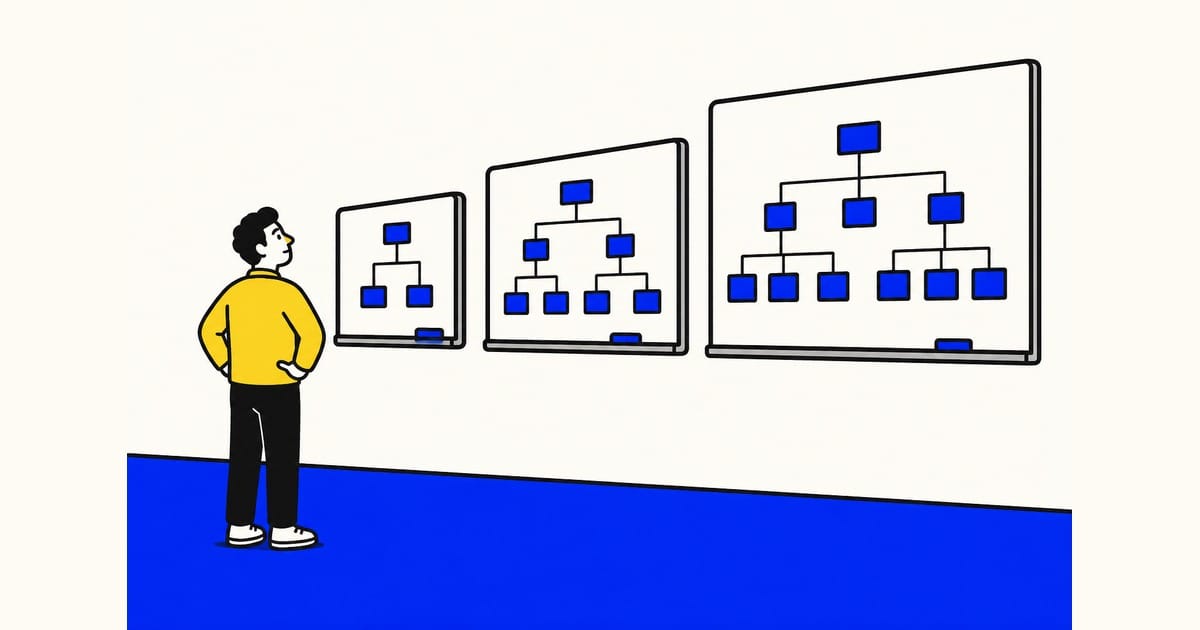

The career ladder examples worth copying come in three structures: a hierarchical ladder where management is the path to seniority, a dual-track ladder with separate IC and management tracks at equal standing, and a skills-based framework that tracks specific skills instead of levels. The structure matters less than one property. A ladder that develops people describes the behaviors, from technical leadership skills to organizational influence, that someone must show to reach the next level, in situations the team actually faces.
A Head of Product I worked with at an edtech company performed at the next level for eighteen months before her title and pay caught up. The ladder existed. It described the destination without a credible path, the organization knew she was above her level, and nobody knew what to do about it. She eventually left.
That outcome was predictable and preventable. The career ladder was working as an evaluation tool. It was not working as a development tool. Those are different things, and most career ladders are only one of them.
Most career ladders are better at describing levels than developing people. They tell someone where they are. They do not tell someone how to get to where they want to go.
The Difference Between Evaluation and Development
A level description answers: what does someone at this level do? A development tool answers: what does someone need to demonstrate to move from this level to the next, and what are the realistic ways to build those skills in this specific organization?
Most career ladders are the first thing and not the second. The gap matters because telling someone they need to demonstrate 'strategic thinking' or 'organizational influence' without helping them understand what that looks like in practice is not useful guidance. It is a rubric for evaluation dressed up as a development framework.
The development question is harder to answer because it is organization-specific. 'Strategic thinking' at a 20-person startup looks different from strategic thinking at a 500-person company. The career ladder that actually develops people is the one that describes behaviors in the context of the decisions and situations that actually arise in the organization.
Hierarchical vs Dual-Track Structures
The traditional hierarchical career ladder was designed for organizations where management was the primary path to seniority and compensation. It works reasonably well for people who want to manage and reasonably poorly for people who want to do deep technical or product work.
The dual-track model - separate IC and management tracks with equivalent compensation and status - solves this in theory. In practice, it requires genuine organizational commitment that most companies do not sustain. The test: does a Principal Engineer have equivalent standing to an Engineering Manager at the same nominal level - in whose input is sought in planning, who is included in leadership discussions, whose career trajectory is actively tracked?
If the honest answer is that the management track has more organizational gravity, the dual track is nominal. The best individual contributors will eventually notice this discrepancy and act accordingly.
What Makes Career Ladders Actually Work
The career ladders that work have three properties. They are written from behavioral evidence rather than abstract competencies - instead of 'demonstrates leadership,' they describe specific behaviors that constitute leadership at each level in the context of real situations the team faces.
They are calibrated to actual decisions in the organization. The examples resonate because they come from real situations: a Principal Engineer at this company is someone who can do X in situation Y, where X and Y are recognizable to anyone in the organization.
And they are maintained - updated when the organization changes rather than written once and treated as permanent. A career ladder written for a 20-person startup is not the right tool for a 200-person company. The ladder needs to change with the organization.
Using Career Ladders in Practice
The most valuable use of a career ladder is not performance evaluation - it is the career conversation it enables. A manager who can sit down with a direct report, look at the ladder together, and have a specific conversation about what the person is doing well and what they need to develop is doing something that creates genuine clarity and motivation.
The practice I recommend: review the career ladder for each direct report before quarterly one-on-ones. Identify one thing they are doing consistently at the next level and name it specifically. Identify one thing that is holding them at their current level and name that specifically too.
The specificity is what makes it useful. 'You are doing well' does not help someone develop. 'The analysis you presented in Q1 planning demonstrated the kind of customer context that distinguishes the next level - here is what made it effective' gives someone a concrete understanding of what to replicate and build on.
The most valuable use of a career ladder is not evaluation - it is the career conversation it enables. Identify one thing each person is doing at the next level. Identify one thing holding them at their current level. Name both specifically.
The Skills-Based Alternative
Some organizations have moved from level-based career ladders to skills-based frameworks - defining the specific skills the organization needs and tracking development at the skill level. This approach has real advantages: it is more specific, it allows people to develop in multiple directions, and it makes the connection between individual development and organizational need more explicit.
The disadvantage is complexity. Skills-based frameworks require more ongoing management and are harder to use consistently across a large organization. They work well in smaller, technically sophisticated organizations where the people using them have the maturity to engage with them honestly.
The practical recommendation: use a level-based framework as the primary structure, with skills-based granularity for the competencies where the level descriptions are too abstract to be useful.
Career Development for Product Leaders
Product leadership career development has a specific challenge: the skills that distinguish senior product leaders - influencing without authority, managing organizational complexity, making product strategy decisions with incomplete information - are hard to develop in a formal program and are almost always developed through direct experience.
The implications: career development for product leaders requires exposure to the kinds of decisions they will need to make at the next level before they are formally at that level. A PM who never participates in a strategic planning process is not developing the skills they will need when they lead one.
Creating this exposure deliberately - assigning people to initiatives that stretch them into the next level, then providing coaching and feedback on how they handled it - is the mechanism that actually develops product leadership talent. The career ladder is the map. The stretch assignments are the vehicle.