
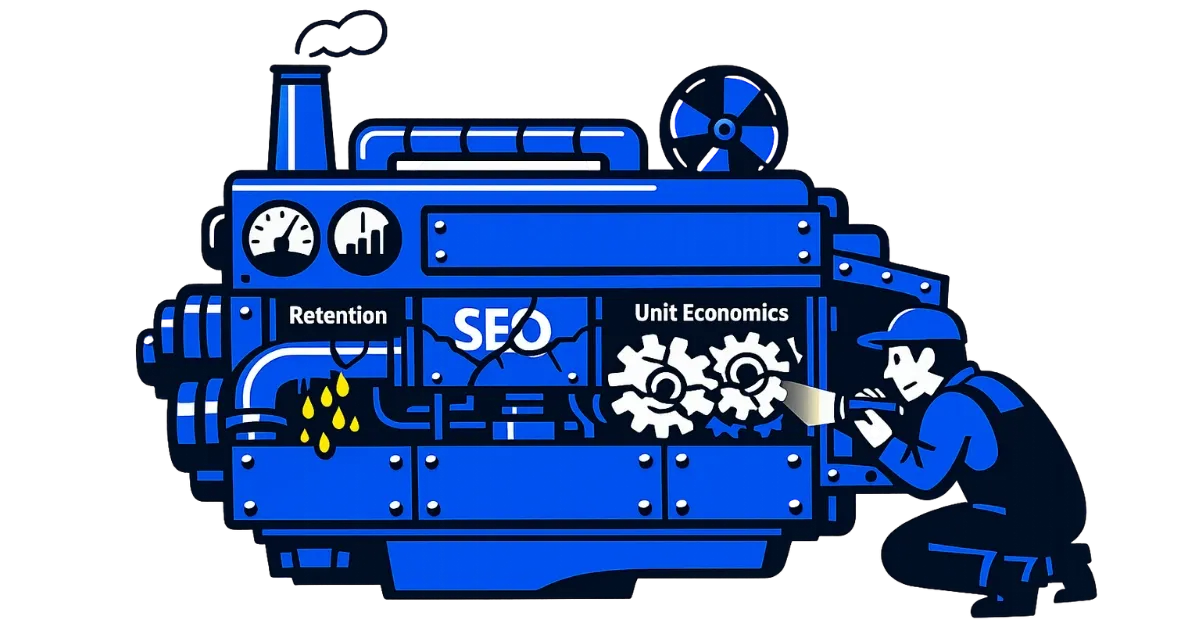
A founder I know raised $90 million, had Google Ventures and General Catalyst on the cap table, and watched his organic search traffic drop 70 percent in twelve months. Revenue was $25 million. Subscription was growing from zero to half of revenue. By most metrics the company was doing well. But the product team was underperforming, the SEO moat was collapsing, and nobody had a clear answer for what came next.
That is not an unusual story for SaaS companies at the $20 to $50 million ARR mark. The tactics that got them there stop working. The org starts running on inertia. And the founding team, which built something real, finds itself managing a machine they no longer fully understand.
I have worked inside or alongside enough SaaS businesses to have seen the same failure modes repeat. What follows is not a list of platitudes. These are the specific patterns that separate companies that break through from companies that plateau.
Build around retention, not acquisition
Most early SaaS teams optimize for acquisition because acquisition is visible. Deals close. Numbers go up. The board sees it. Retention is quieter, harder to attribute, and easier to defer.
At EverQuote, we rebuilt the consumer product around what happened after a user submitted their first insurance quote. The acquisition funnel was already working. The gap was in what came next. Users who had a good second experience converted at dramatically higher rates and referred more. That single focus on the post-submission flow drove more incremental revenue than any top-of-funnel campaign we ran.
The math is simple: improving retention by five points does more for long-term ARR than a 20 percent increase in new logo acquisition, at a fraction of the cost. Most SaaS companies do not actually believe this until they model it out. Model it out.
Know your unit economics before you scale
CAC and LTV are not metrics you track. They are the structural constraints everything else runs inside of. If you do not know them precisely, every growth decision you make is a guess.
The SaaS businesses I have seen fail at scale almost always had the same problem: they were acquiring customers at a cost they did not fully understand, and the payback period was longer than their runway could absorb. The early cohorts looked fine because they were small. The moment they put real marketing dollars behind a channel, the economics collapsed.
Sequence your market expansion deliberately
One of the most common growth mistakes in SaaS is expanding into adjacent verticals or customer segments before the core business is deep enough to defend. The logic feels sound: more market means more revenue. The reality is that you dilute engineering focus, confuse the go-to-market motion, and end up with a product that does three things adequately instead of one thing well.
At EverQuote, we expanded from auto insurance into home, life, and health sequentially. Each vertical got a dedicated test with minimum viable supply and demand before we committed engineering resources. The sequencing was deliberate. We did not open the next vertical until the prior one had proven unit economics. The result was $200 million in incremental revenue added in a way that did not break the core product or the team.
At Acquia, the pressure was different. We were fighting a two-front war: defending against Contentful and Prismic taking the low end of the market, while trying to push up into the enterprise DXP space against Adobe and Sitecore. Trying to win both simultaneously was not viable. The answer was a product-led motion that let us qualify buyers earlier, so the sales team only engaged with accounts that were ready for the enterprise motion. Same resource constraint, better sequencing.
Treat churn as a product problem, not a customer success problem
Most SaaS companies respond to churn by adding customer success headcount. That is the right move when churn is caused by poor onboarding or low engagement. It is the wrong move when churn is caused by a product that does not deliver enough value.
The way to diagnose the difference: look at your highest-retention cohort and your lowest-retention cohort. What is different about them? If the answer is usage patterns, you have a product problem. If the answer is onboarding completion, you have a customer success problem. If the answer is company size or segment, you may have a positioning problem. Each diagnosis requires a different fix.
Do not confuse activity with progress
Growing SaaS companies generate enormous amounts of activity. Sprints, launches, roadmap reviews, pipeline reviews, QBRs. The teams that plateau are usually the ones where activity became a substitute for outcome accountability. Everyone is busy. Nothing is moving.
The intervention that works is forcing explicit bets with clear success criteria before you build. Not a list of features. A specific hypothesis: if we build X, we expect Y to change by Z within N weeks. When the answer comes back, you honor it. You do not move the goalposts because the result is inconvenient.
Your pricing model is a product decision
SaaS pricing is treated as a revenue operations problem when it is actually a product strategy problem. The pricing model you choose shapes which customers you attract, how they use the product, what they ask you to build, and how defensible your position becomes over time.
Seat-based pricing made sense when software was expensive to deploy. It creates misaligned incentives in a world where usage is the value driver. Usage-based pricing aligns incentives but makes forecasting harder. The right answer depends on your buyer, your sales motion, and what behavior you want to reinforce. There is no universal answer, but the decision deserves first-principles thinking, not benchmark-chasing.
Build for defensibility, not just growth
The SaaS companies that win long-term build structural advantages that compound. Data network effects. Workflow lock-in. Integration depth that makes switching painful. These are not accidents. They are the result of product teams that think two or three years ahead about what makes the product genuinely hard to replace.
The question to ask at every major roadmap decision: does this make our product more or less defensible? Features that grow revenue without deepening lock-in are table stakes. Features that deepen lock-in are the ones worth fighting for.